Business Plan Outline: The 10 Sections and What Goes in Each

Before you write a business plan, it helps to see the whole thing on one page: which sections it has, what each one has to answer and roughly how much space each deserves. This is that page. It gives you a business plan outline you can copy, explains what readers look for in each section, and shows how the structure changes for a lean plan, a traditional plan and a grant or accelerator application.
- 13 plan sections in a set order, from Concept to Traction
- An explanation and an example answer next to every section
- Share as a live link or export a PDF with cover, table of contents and page numbers
The Business Plan Outline at a Glance
Most business plans follow the same basic structure. The U.S. Small Business Administration lists the sections of a traditional plan as executive summary, company description, market analysis, organization and management, service or product line, marketing and sales, funding request and financial projections. Most plans add an appendix for supporting documents. For a startup, it helps to split two of those out: competition deserves its own section, and so do milestones and risks. That gives you ten sections plus an appendix, in the order a reader expects them:
- Executive summaryThe whole plan on one page
- Company descriptionWho you are and why
- Problem and solutionWhat you sell and why it works
- Market analysisWho buys, and how many
- CompetitionWhat customers use today
- Marketing and salesHow customers find you
- Operations and milestonesHow it runs, what comes next
- TeamWho does the work
- Financial planCosts, revenue, cash
- Funding requestWhat you need and why
The order runs from outside to inside and from story to numbers. A reader first learns what the business is, then whether the opportunity is real, then how you will win it, and only then what it costs. That is also why the financial plan sits near the end: by the time a reader gets there, each number should confirm something they have already read.
This page is about structure. If you want the process, meaning which section to write first and how to fill each one in, our step-by-step guide on how to write a business plan covers it with a worked example.

The 10 Business Plan Sections and What Goes in Each
Here are the parts of a business plan in one table: the question each section answers, a sensible length for a startup plan of about 20 pages, and what an investor or reviewer is actually checking when they read it.
| Section | Question it answers | Typical length | What readers look for |
|---|---|---|---|
| 1. Executive summary | What is this business and what do you want? | 1 page | A clear one-liner, traction and a specific ask |
| 2. Company description | Who are you, where are you, what stage are you at? | 0.5 to 1 page | Mission, legal form, location, founding date, stage |
| 3. Problem and solution | What is broken, and how does your product fix it? | 1 to 2 pages | A specific customer with a costly problem; a product described in the customer’s words |
| 4. Market analysis | Who buys, how many are there, and what are they worth? | 2 to 3 pages | A first segment sized bottom up, with sources for every input |
| 5. Competition | What do customers use today, and why would they switch? | 1 to 2 pages | At least three alternatives, including doing nothing, and an honest advantage |
| 6. Marketing and sales | How do customers find you, and what does each one cost? | 1 to 2 pages | Two or three concrete channels, with costs that match the financial plan |
| 7. Operations and milestones | How does the business run, and what happens in the next 12 to 36 months? | 1 to 2 pages | Key partners and suppliers, dated milestones, named risks with responses |
| 8. Team | Why can these people pull it off? | 0.5 to 1 page | Relevant experience, ownership, and the gaps you still need to fill |
| 9. Financial plan | What does it cost, what does it earn, and when does cash run low? | 3 to 5 pages | Assumptions, monthly cash flow for year one, break-even, runway |
| 10. Funding request | How much do you need, for what, and what does it get you to? | 0.5 to 1 page | An amount, use of funds and the milestone it reaches |
| Appendix | Where is the evidence? | As needed | Detailed financials, résumés, letters of intent, survey results |
Lengths are a guide for a startup plan of roughly 20 pages, not a rule. The appendix is not counted.
1. Executive summary
One page that stands on its own. It covers the problem, the solution, the market, the business model, traction, the team, key financial figures and the ask. It comes first in the document, but you write it last. Our guide on how to write an executive summary has a template and three full examples.
2. Company description
The facts about the company: name, legal structure, location, founding date, stage and ownership, plus your mission and, if you have one, a vision statement. Keep it short. Readers use this section to place you, not to be persuaded. See our company description guide for examples.
3. Problem and solution
Some outlines call this “products and services.” For a startup it works better framed as a problem and a solution: who has the problem, what it costs them, and what your product does about it. Include price and how the product reaches the customer here if you do not give them their own section. Our guides to the problem statement and the unique value proposition go deeper.
4. Market analysis
Market size (TAM, SAM and SOM), your target customer segments, and the trends that make now the right time. The best market sections show the calculation: number of customers times price, for the segment you will actually sell to first. Our guide to market analysis walks through it.
5. Competition
The alternatives your customer has today, what each does well, where each falls short for your customer, and your advantage. A comparison table and a SWOT analysis both work well here.
6. Marketing and sales
Positioning, the channels you will use to reach your first customers, what each channel costs, and how a lead becomes a paying customer. The numbers here must match the revenue forecast: if the marketing budget buys 30 customers a month, the forecast cannot assume 100.
7. Operations and milestones
How the business actually runs: key resources, key activities, suppliers and partners. Then a dated roadmap for the next 12 to 36 months and the three to five biggest risks, each with a response. Many traditional outlines fold this into other sections; for a startup, a reader wants to see milestones and risks in one place.
8. Team
Founders, key hires and advisors, each with two or three lines of relevant experience. The SBA calls this section “organization and management,” includes your legal structure in it, and suggests an organizational chart showing who is in charge of what. For a startup, name the gaps too and how you plan to fill them.
9. Financial plan
Startup costs, a revenue forecast, operating costs, a profit and loss projection, a cash flow forecast and the break-even point, with the assumptions written out. For a new business, the SBA suggests a financial outlook for the next five years, with quarterly or even monthly projections for the first year. Many early-stage startups show three years, with year one by month. Our guide to financial projections covers the full set.
10. Funding request
How much you are raising or applying for, what you will spend it on (in categories with amounts), what it gets you to, and over what time. If you are not raising money, replace this with a short section on how the business is funded.
Example: A Page Budget for a 20-Page Plan
A page budget is a simple way to keep the plan balanced before you write. Decide the total length, give each section a share, and treat the numbers as a ceiling.
Greenline Tutors is a fictional online math tutoring startup for middle school students, writing a plan for seed investors after a first meeting. The founders set a limit of 20 pages plus an appendix, and gave the most space to the two sections investors asked about in that meeting: the market and the financial plan.
| Section | Pages | Share |
|---|---|---|
| Executive summary | 1 | 5% |
| Company description | 1 | 5% |
| Problem and solution | 2 | 10% |
| Market analysis | 3 | 15% |
| Competition | 2 | 10% |
| Marketing and sales | 2 | 10% |
| Operations and milestones | 2 | 10% |
| Team | 1 | 5% |
| Financial plan | 5 | 25% |
| Funding request | 1 | 5% |
| Total | 20 | 100% |
Illustrative. Greenline’s appendix holds a parent survey, two school pilot letters and the detailed monthly forecast, and is not counted in the 20 pages.
The budget did two useful things for Greenline. It stopped the product section from growing to six pages of feature descriptions, which is where founders who build the product tend to overspend. And it forced a decision early: with only three pages for the market, the founders had to choose one first segment (parents of seventh and eighth graders in three states) rather than describing every possible market.
Business Plan Outline Template (Copy and Paste)
Copy this outline into a document and use the sub-points as prompts. Delete the prompts as you replace them with your own content. If a sub-point does not apply to your business, remove it rather than writing around it.
- Executive summary (write last)
- One-line description: [what you do, for whom]
- Problem, solution, market, business model
- Traction to date: [numbers and dates]
- Team in one or two lines
- Key financials and the ask: [amount, use, milestone]
- Company description
- Name, legal form, location, founding date: [facts]
- Mission statement and vision statement
- Stage and ownership
- Problem and solution
- The problem: [customer] and what it costs them
- The solution and how it works
- Unique value proposition
- Price and distribution
- Market analysis
- Market size: TAM, SAM, SOM with sources
- Target segments and customer personas
- Trends and why now
- Validation: interviews, surveys, pilots
- Competition
- Direct and indirect alternatives, including doing nothing
- Comparison table: strengths and weaknesses
- Your competitive advantage
- SWOT analysis
- Marketing and sales
- Positioning
- Channels with cost per customer: [channel, $]
- Sales process and customer relationship
- Operations and milestones
- Business model, key resources, key activities, key partners
- Key metrics you will track
- Roadmap: [milestone, date] for 12 to 36 months
- Top risks and how you will respond
- Team
- Founders: role, relevant experience, ownership
- Key hires, advisors, and the gaps you will fill
- Financial plan
- Assumptions
- Startup costs
- Revenue forecast and operating costs
- Profit and loss projection, cash flow forecast (monthly for year one)
- Break-even point and runway
- Funding request
- Amount: [$]
- Use of funds by category
- Milestone it reaches and by when
- Appendix
- Detailed financial tables, résumés, letters of intent, research data
Prefer a finished document to fill in? Our free startup business plan template follows the same structure.
Business Plan Format: Lean, Traditional or Grant
The outline above is the traditional business plan format. Two other formats use the same building blocks with a different weight.
| Lean or one-page plan | Traditional plan | Grant or accelerator application | |
|---|---|---|---|
| Length | 1 page | 10 to 30 pages plus appendix | Set by the funder, often a web form with word limits |
| Structure | A grid of short boxes | The 10 sections above | The funder’s questions, in the funder’s order |
| Best for | Testing an idea, a first investor email, internal alignment | Seed investors after a first meeting, partners, detailed planning | A specific program with published criteria |
| Extra emphasis | Value proposition, customers, channels, revenue, costs | Market, financials, risks | Eligibility, impact, budget and use of funds |
Lean or one-page plan
The SBA describes the lean startup plan as typically one page, built from nine components: key partnerships, key activities, key resources, value proposition, customer relationships, customer segments, channels, cost structure and revenue streams. Those are the nine boxes of the Business Model Canvas. It skips the narrative and most of the numbers, which makes it fast to write and easy to change. See our guide to the one-page business plan for a layout.
Traditional plan
The full outline, with every section written out and a financial plan attached. It takes longer, but it is what most investors, incubators and partners expect once they are seriously interested. You can write it by expanding a lean plan: every box on the canvas becomes a paragraph or a section.
Grant or accelerator application
Here the funder sets the structure. Answer their questions in their order, using their headings, even if it means splitting your market section across three answers. Your traditional plan is still the source for every answer; you are rearranging it, not rewriting it. The startup grants database lists 1,357 grants by country, with amounts, deadlines and who can apply, so you can check the criteria before you start.
What a Finished Business Plan Looks Like
Laid out as a document, a traditional plan has a predictable shape. A cover page with the company name, logo, date and contact details. A table of contents with page numbers. The executive summary on its own page. The sections in order, each starting with a heading that matches the table of contents. Charts and tables inside the financial plan rather than pasted as images at the end. Then the appendix.
Readers skim first. Headings, tables and a chart or two let them find the section they care about in seconds, which is why a well-structured 15-page plan often gets read more closely than a dense 8-page one.

How Cuttles’ 13 Sections Map to the Classic Outline
Cuttles splits the plan into 13 sections instead of 10. The content is the same; some classic sections are divided into smaller parts so each one is easier to write. Here is how they line up, including the two places where Cuttles has no dedicated section:
| Classic outline | Cuttles section (fields) |
|---|---|
| Executive summary | Concept (Introduction). There is no separate executive summary section: the Introduction opens the plan, and the one-page pitch view is the short version. |
| Company description | Concept (Mission Statement, Vision Statement) |
| Problem and solution | Opportunity (Problem, Solution, Unique Value Proposition) and Product (Product, Price, Distribution) |
| Market analysis | Market (Market, Market Size, Market Validation) and Customers (Customers, Customer value, Personas) |
| Competition | Competitors (overview, Competitive Advantages, competitor cards with features, strengths and weaknesses) |
| Marketing and sales | Marketing (Marketing Channels, Customer Relationship, Brand Positioning) |
| Operations and milestones | Business Strategy (Business Model, SWOT Analysis, Key Resources, Key Activities, Key Metrics, Key Partnerships), Roadmap (milestones with start, end, status, priority) and Risks & Challenges |
| Team | Team |
| Traction (part of several classic sections) | Traction |
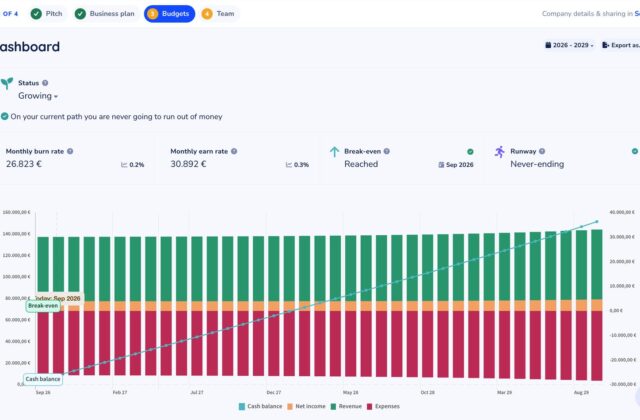
| Financial plan | Financials (Runway, Expenses, Revenue, Capital), with charts pulled from your budget |
| Funding request | No dedicated section. State the ask in the Introduction, and show the capital you have and plan to raise in the budget, which feeds Financials. |
| Appendix | No appendix section. Keep supporting documents separately and send them with the plan. |
Cuttles’ 13 sections, in order: Concept, Opportunity, Market, Product, Business Strategy, Competitors, Customers, Marketing, Financials, Roadmap, Risks & Challenges, Team, Traction.
Two differences are worth knowing. Traction gets its own section in Cuttles, because for an early-stage startup it is often the strongest evidence in the plan, while classic outlines spread it across the summary and the market analysis. And the Financials section is not typed in: it shows charts from the multi-year budget, so when you change a cost or a price in the budget, the plan updates.

Each section has a guide text with an example answer, and there is a full example plan you can open to see a finished version. If you would rather start from a complete sample in your industry, the Templates tab holds nine industry templates with the pitch, plan sections, SWOT, personas, competitors and a three-year budget filled in; you copy one and rewrite it with your own idea. On the Grow and Series plans, [AI] Rewrite this and [AI] Polish can tighten text you have written in any field. Plans start at €8 a month on a yearly plan; see pricing or how it works.
A spreadsheet and a word processor will do the same job if you prefer to build the structure yourself. What you give up is the guidance next to each section and the link between the budget and the financial pages.
Business Plan Structure Checklist
- The plan has all ten sections, or you have a reason for each one you dropped.
- The executive summary is one page and was written after the other sections.
- Sections appear in the order the table of contents lists them, with matching headings.
- Problem and solution describe one specific customer, not a whole industry.
- The market section shows the calculation behind the market size.
- Competition lists at least three alternatives, including doing nothing.
- Marketing costs and customer numbers match the revenue forecast.
- Milestones have dates, and risks have responses.
- The financial plan includes a monthly cash flow for year one and the break-even point.
- The funding request states an amount, the use of funds and the milestone it reaches.
- Supporting evidence sits in the appendix, not in the middle of the plan.
- If you are applying to a specific funder, the structure follows their questions instead.
Sources
- U.S. Small Business Administration, Write your business plan (sections of a traditional plan, the nine lean startup components, and guidance on financial projections).
- Greenline Tutors is a fictional company. The page budget is illustrative.
Get the structure right first, and every section knows what it has to prove. — Cuttles