How to Make a Cash Flow Forecast for a Startup (Example + Template)

A startup can have a good month on paper and still be unable to pay rent. Customers pay 30 days late, stock has to be bought three months ahead, and the one-off costs all land at the start. A cash flow forecast shows you, month by month, when that squeeze comes, so you can deal with it while you still have options.
- A multi-year budget with recurring and one-time items, each with its own start date and growth rate
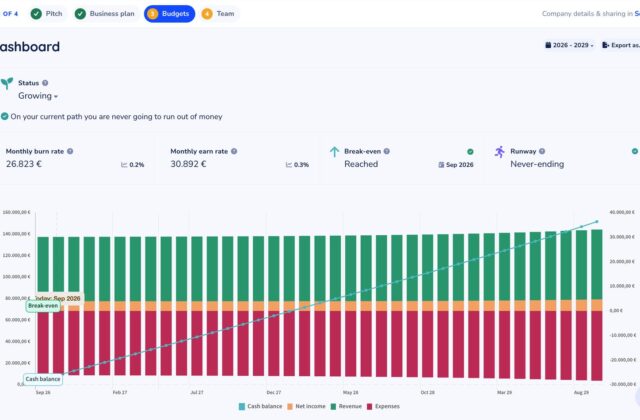
- A dashboard that shows burn rate, earn rate, break-even month and runway
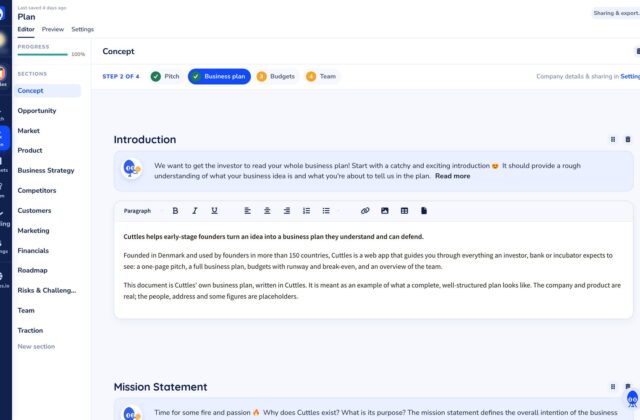
- Budget charts that appear in the Financials section of your business plan automatically
Why Cash and Profit Are Not the Same Number
Profit tells you whether the business makes money over a period. Cash tells you whether you can pay the bills this month. For a young company the two drift apart for four reasons:
- Payment terms. If you sell to businesses on 30-day terms, a sale you make in March becomes cash in April. The profit and loss statement counts it in March; your bank account sees it a month later.
- Upfront costs. Equipment, deposits and a first batch of stock are paid before you sell anything. An accountant spreads equipment over several years in the profit figures. Your bank balance takes the full hit on the day you pay.
- Stock bought ahead. A product business often pays for three months of inventory in one go. The cost shows up in profit as the goods sell, but the cash leaves on the day the supplier’s invoice is due.
- Money that is not revenue. Founder capital and investment are cash in, but not profit. Sales tax or VAT you collect passes through your account on its way to the government, so it is cash you hold for a while but never own.
Here is what that looks like in one month for the fictional hot sauce company we use throughout this guide. In April it sells $3,000 online and invoices grocery stores $3,000, so the sales figure is $6,000. Cash in is only $5,000: the $3,000 of online orders plus the $2,000 a store owes from March. Cash out is $15,400, because the founder pays for the next three months of bottled sauce ($7,500) that same month. A month with $6,000 of sales ends with $10,400 less in the bank. Nothing is wrong with the business. The timing is simply against it, and only a cash flow forecast shows that.
The U.S. Small Business Administration draws the same line in its guidance on managing business finances: under the cash method of accounting, income is recorded only once payment has been received, which shows cash flow clearly. The British Business Bank’s guide to cash flow forecasting puts it in practical terms: enter each amount in the month it actually reaches or leaves your bank account.

What Goes Into a Cash Flow Forecast
A cash flow forecast (people also say cash flow projection; for a startup plan the two terms mean the same thing) is a table. Each column is a period, usually a month. Each row is a type of cash coming in or going out. Five lines do all the work:
| Line | What it contains | Common mistake |
|---|---|---|
| Opening cash | What is in the bank on day one of the month. Month 1 uses your real balance; every later month uses last month’s closing cash. | Typing a number in each month instead of linking it to the month before. |
| Cash in | Customer payments, capital from founders or investors, grants received, tax refunds, sale of assets. | Entering sales in the month you invoice instead of the month the customer pays. |
| Cash out | Stock, rent, salaries, founder pay, marketing, software, insurance, equipment, tax payments, repayments of any money you owe. | Forgetting annual and quarterly bills: insurance, software paid yearly, tax. |
| Net cash flow | Cash in minus cash out for the month. Negative is normal for a young startup. | Reading a negative month as failure. What matters is where the balance ends. |
| Closing cash | Opening cash plus net cash flow. This is the row you watch. | Not checking which month has the lowest closing balance. |
Leave out anything that does not move cash. Depreciation is a profit figure, not a payment. A customer order you have not been paid for is a receivable, not cash. A grant you have applied for is a hope; put it in only once the award letter arrives, and then in the month the money is paid out.
How to Make a Cash Flow Forecast in 7 Steps
This is the direct method: you list actual cash receipts and payments rather than starting from profit and adjusting it. It is the easiest version to build from scratch and the easiest for someone else to check.
- Pick the period12 months, monthly columns
- Opening balanceReal cash on day one
- Cash inBy the month it lands
- Cash outBy the month you pay
- One-offsEquipment, deposits, tax
- Net and closingChain the months
- Find the low pointAnd decide what to do
Step 1: Choose the period and the columns
For a business plan, a 12-month cash flow forecast in monthly columns is the standard. Investors and grant reviewers then usually want years two and three by quarter or by year. If cash is already tight, add a 13-week forecast in weekly columns on top of the monthly one: it catches the week when payroll and a supplier bill land before a big customer pays.
Step 2: Start from your real opening balance
Use the actual figure in your business account, not the amount you hope to raise. If you are pre-launch and the founders will put money in during month 1, start at zero and show that capital as cash in.
Step 3: List cash in, by the month it arrives
Build each revenue line from volume times price, then shift it by your payment terms. Card and online payments usually arrive within days, so they sit in the month of sale. Business customers on 30-day terms pay the month after you invoice; on 60-day terms, two months after. If you have not sold to a customer type before, assume they pay late. Your sales forecast supplies the volumes; the cash flow forecast moves them to the right month.
Step 4: List cash out, by the month you pay
Go through your bank statements or quotes and put every cost in the month it leaves the account. Group them into lines you can read at a glance: stock or materials, rent, people, marketing, software and admin. Watch the lumpy ones. A supplier who wants payment upfront for a production run puts a big number in one month and nothing in the next two.
Step 5: Add one-off and irregular items
Equipment, deposits, a website build, annual insurance, quarterly sales tax or VAT, and yearly software plans all belong here. Founders forget these more than anything else, because they do not show up in a typical month. Our guide to startup costs has a list to check against.
Step 6: Calculate net cash flow and closing cash
Subtract cash out from cash in for each month, add the result to opening cash, and carry the closing balance into the next month. Then add two check rows: total cash in for the year minus total cash out for the year should equal the change between the first opening balance and the last closing balance.
Step 7: Find the lowest month and decide what to do
Scan the closing cash row for the smallest number. That is the month the forecast exists for. If it is negative, you need more money, lower costs or faster payments before that month arrives. If it is positive but thin, decide what buffer you want to hold and plan for it now.
A 12-Month Cash Flow Forecast Example
Saltmarsh Sauce Co. is a fictional small-batch hot sauce brand in Portland, Oregon. All numbers below are illustrative, but every row adds up, so you can check the method line by line.
Capital: the founder and two friends put in $50,000 in month 1.
Online sales: $1,200 in month 1, growing by $600 a month to $3,000 in month 4, then by $400 a month to $6,200 in month 12. Customers pay at checkout, so cash arrives the same month.
Wholesale: grocery stores start ordering in month 3 ($2,000), rising by $1,000 a month to $9,000 in month 10, $9,000 in month 11 and $10,000 in month 12. Stores pay on 30-day terms, so each month’s invoices become cash the following month.
Production: a co-packer makes three months of stock at a time and wants payment upfront: $6,000 in month 1, $7,500 in month 4, $9,000 in month 7 and $10,500 in month 10.
One-off: $9,000 in month 1 for labels, bottling molds, a market stand and the website.
Monthly costs: shared kitchen and storage $1,500, founder pay $2,500, marketing $1,500 ($2,500 in the launch month), software, insurance and card fees $400, and a part-time helper at $2,000 a month from month 4.
| Illustrative ($) | M1 | M2 | M3 | M4 | M5 | M6 | M7 | M8 | M9 | M10 | M11 | M12 |
|---|---|---|---|---|---|---|---|---|---|---|---|---|
| Opening cash | 0 | 29,300 | 25,200 | 21,700 | 11,300 | 9,800 | 9,700 | 2,000 | 4,700 | 8,800 | 3,800 | 10,700 |
| Online sales | 1,200 | 1,800 | 2,400 | 3,000 | 3,400 | 3,800 | 4,200 | 4,600 | 5,000 | 5,400 | 5,800 | 6,200 |
| Wholesale receipts (30 days) | 0 | 0 | 0 | 2,000 | 3,000 | 4,000 | 5,000 | 6,000 | 7,000 | 8,000 | 9,000 | 9,000 |
| Founder and investor capital | 50,000 | 0 | 0 | 0 | 0 | 0 | 0 | 0 | 0 | 0 | 0 | 0 |
| Total cash in | 51,200 | 1,800 | 2,400 | 5,000 | 6,400 | 7,800 | 9,200 | 10,600 | 12,000 | 13,400 | 14,800 | 15,200 |
| Production batches | 6,000 | 0 | 0 | 7,500 | 0 | 0 | 9,000 | 0 | 0 | 10,500 | 0 | 0 |
| Equipment and website (one-off) | 9,000 | 0 | 0 | 0 | 0 | 0 | 0 | 0 | 0 | 0 | 0 | 0 |
| Kitchen and storage | 1,500 | 1,500 | 1,500 | 1,500 | 1,500 | 1,500 | 1,500 | 1,500 | 1,500 | 1,500 | 1,500 | 1,500 |
| Part-time helper | 0 | 0 | 0 | 2,000 | 2,000 | 2,000 | 2,000 | 2,000 | 2,000 | 2,000 | 2,000 | 2,000 |
| Founder pay | 2,500 | 2,500 | 2,500 | 2,500 | 2,500 | 2,500 | 2,500 | 2,500 | 2,500 | 2,500 | 2,500 | 2,500 |
| Marketing | 2,500 | 1,500 | 1,500 | 1,500 | 1,500 | 1,500 | 1,500 | 1,500 | 1,500 | 1,500 | 1,500 | 1,500 |
| Software, insurance, fees | 400 | 400 | 400 | 400 | 400 | 400 | 400 | 400 | 400 | 400 | 400 | 400 |
| Total cash out | 21,900 | 5,900 | 5,900 | 15,400 | 7,900 | 7,900 | 16,900 | 7,900 | 7,900 | 18,400 | 7,900 | 7,900 |
| Net cash flow | 29,300 | −4,100 | −3,500 | −10,400 | −1,500 | −100 | −7,700 | 2,700 | 4,100 | −5,000 | 6,900 | 7,300 |
| Closing cash | 29,300 | 25,200 | 21,700 | 11,300 | 9,800 | 9,700 | 2,000 | 4,700 | 8,800 | 3,800 | 10,700 | 18,000 |
Check: total cash in for the year is $149,800 ($50,000 capital + $46,800 online + $53,000 wholesale receipts). Total cash out is $131,800. The difference, $18,000, equals the closing cash in month 12. The $10,000 of wholesale invoices from month 12 is still owed and arrives in month 13.
Read the table the way an investor would. Sales grow every single month, from $1,200 to $16,200 (online plus wholesale invoiced). Net cash flow is negative in seven of the twelve months anyway, and the three deepest drops after launch (months 4, 7 and 10) are all production batches. By month 11 a month without a batch adds about $7,000 of cash, which is the first sign the business can carry its own stock purchases in year two.
The Month Cash Runs Lowest, and What to Do About It
Saltmarsh’s closing cash bottoms out at $2,000 in month 7, the month the third production batch is paid. That is about one week of normal costs: monthly cash out outside a batch month is $7,900. One store paying two weeks late, one broken bottling machine, and the founder cannot pay the helper. Month 10 is the second pinch point at $3,800.
A forecast that stops at “we are positive all year” misses the point. The useful question is how much buffer you want, and how to get it. Here are the founder’s options, each with its effect on the month 7 low:
| Option | What changes | Month 7 closing cash |
|---|---|---|
| Do nothing | Base case | $2,000 |
| Raise $15,000 more in month 1 | Every month’s closing cash rises by $15,000 | $17,000 |
| Split the month 7 batch in two | $4,500 in month 7 and $4,500 in month 8, if the co-packer agrees | $6,500 |
| Delay the helper by three months | Hire in month 7 instead of month 4, saving $6,000 before month 7 | $8,000 |
| Cut founder pay to $1,500 for months 1 to 7 | Saves $1,000 a month for seven months | $9,000 |
Each row changes one assumption and leaves the rest of the base case untouched (illustrative).
No option is free. More capital means more dilution or more owner money at risk. Splitting batches often raises the price per bottle. A later hire means the founder does the packing. What a forecast gives you is the choice, made in month 1, instead of a scramble in month 7.
A common rule of thumb is to keep at least two to three months of fixed costs in the bank at the low point. For Saltmarsh, two months of non-batch costs is $15,800, so the extra $15,000 raise is the option that meets that bar on its own. Our guide to burn rate and runway goes into how to set that buffer.
Try it with your own numbers. The calculator shows how many months your cash lasts at your current monthly burn.
Free calculator: burn rate and runway
Your burn and runway
Turn these numbers into a full business plan with budgets, runway and a pitch. 7-day free trial, plans from €8/month.
Scenario Planning: Base, Slow and Fast Cases
A single forecast is one guess. Three versions show how sensitive the business is to the two or three assumptions that matter most. For Saltmarsh, those are online sales and how quickly stores pay.
| Scenario | Changed assumptions | Lowest closing cash | Month |
|---|---|---|---|
| Fast | Online sales 20% higher than base | $5,960 | 7 |
| Base | As in the table above | $2,000 | 7 |
| Slow | Online sales 20% lower, stores pay in 60 days instead of 30 | −$11,160 | 10 |
Illustrative. In the slow case, closing cash first turns negative in month 7 (−$6,960) and ends the year at −$360.
The slow case is the one to take seriously. Slower payment alone moves a full month of wholesale income out of the year, and lower online sales remove $9,360. If the founder raises the extra $15,000, even the slow case bottoms out at $3,840 instead of −$11,160. That one line is often the most persuasive number you can put in the financial section of a plan: “we have modeled the slow case, and we can survive it.”
Keep scenarios simple. Change two or three inputs, not twenty, and label each version clearly. If you build your full financial projections on the same assumptions, the scenarios carry over to profit and break-even too.
Cash Flow Forecast Template
Copy this layout into a spreadsheet, extend it to 12 monthly columns, and fill it from the top down. Delete any row that does not apply to your business.
| Line | Month 1 | Month 2 | Month 3 | … Month 12 |
|---|---|---|---|---|
| Opening cash | [bank balance] | = M1 closing | = M2 closing | = M11 closing |
| Customer payments: paid at sale | ||||
| Customer payments: on terms (shifted) | ||||
| Capital from founders or investors | ||||
| Grants received (only once awarded) | ||||
| Total cash in | ||||
| Stock, materials, production | ||||
| Salaries, contractors, founder pay | ||||
| Rent and utilities | ||||
| Marketing | ||||
| Software, insurance, fees | ||||
| Equipment and other one-offs | ||||
| Sales tax or VAT paid, other taxes | ||||
| Total cash out | ||||
| Net cash flow | = in − out | |||
| Closing cash | = opening + net |
Write your assumptions next to the table, not in your head. A reader who disagrees with a number should be able to find where it came from in ten seconds.
Opening cash: [$ amount] on [date], from [bank statement or planned capital].
Sales: [units or customers] in month 1, growing by [number or %] a month because [channel, hire or launch]. Price [$].
Payment timing: [share] paid at sale, [share] on [30/60]-day terms.
Stock: bought every [number] months, paid [upfront / on delivery / 30 days].
One-offs: [item, $, month]. Tax payments: [type, $, month due].
Minimum buffer: never below [$], which is [number] months of fixed costs.
If you need the full cost side first, the startup budget template walks through every category.
UK Notes: A £ Example and VAT Timing
The method is identical in the UK, with one line that catches many first-time founders: VAT. According to GOV.UK, you must register for VAT if your taxable turnover goes over £90,000, and you can register voluntarily below that. The standard rate is 20%. Once registered, the VAT you charge customers sits in your account until you pay it to HMRC, so a VAT-registered business needs it in the forecast as a separate line.
GOV.UK states that VAT returns are usually sent every 3 months, and that the deadline for filing and paying is usually one calendar month and 7 days after the end of the accounting period. Under standard VAT accounting you report VAT on the invoices you issue and receive, even if they have not been paid yet.
A VAT-registered design studio invoices £30,000 plus £6,000 VAT in the quarter, so customers pay it £36,000 in total. It pays £4,000 of VAT on its own purchases in the same quarter. It owes HMRC £6,000 − £4,000 = £2,000.
The quarter ends on 31 March, so the return and the payment are due by 7 May. In the forecast, the £36,000 goes into cash in as customers pay, and the £2,000 goes into cash out in May. If a client with a £12,000 invoice (including £2,000 of VAT) has not paid by then, the studio still owes HMRC the VAT on that invoice under standard accounting.
GOV.UK also describes the VAT Cash Accounting Scheme, open to businesses with VAT taxable turnover of £1.35 million or less, under which you pay VAT on sales when your customers pay you and reclaim VAT on purchases when you have paid your supplier. Whether that scheme or another suits your business is a question for an accountant; the point for your forecast is to put VAT in the month it is actually paid. Build the UK forecast in £ throughout, and keep the VAT line separate from revenue so your sales figures stay net of VAT.
Spreadsheet or Budget Software?
A spreadsheet is a perfectly good home for a cash flow forecast. It handles payment terms, weekly columns and odd one-offs in any shape you want, as long as you are comfortable building and checking the formulas. The risk is not the spreadsheet itself. It is that the spreadsheet and the business plan drift apart: the plan says runway is 14 months, the latest version of the model says 9.
In Cuttles, the budget holds your expenses, revenue and capital as items. Each one is recurring or one-time, with a start date, an end date, an amount, a period and a growth rate, so a helper hired in month 4 or a batch paid every third month is one item each. To reflect payment terms, date the revenue item to the month the cash arrives rather than the month you invoice. The dashboard then shows monthly burn rate, earn rate, the break-even month and runway, and the Report tab gives you a year-by-year table of capital, expenses, revenue and cash balance across the budget period (the example runs from 2026 to 2029).

You can keep several budgets per startup, which is a simple way to hold a base, slow and fast case side by side. Whichever one you pick feeds the Financials section of the plan: runway, expenses, revenue and capital charts appear there automatically, so the numbers in your plan and your budget cannot disagree.

A fair trade-off: if you need a 13-week forecast by week, or a model with dozens of payment rules, a spreadsheet gives you more control. If you want the forecast and the business plan to stay in step while you change assumptions, a budget connected to the plan saves you the copying. See plans and pricing; every plan starts with a 7-day free trial.
Cash Flow Forecast Checklist
- Month 1 opening cash is your real bank balance, or zero if capital arrives in month 1.
- Every month’s opening cash equals the previous month’s closing cash.
- Customer payments sit in the month the cash arrives, shifted by your payment terms.
- Capital and grants are shown as cash in, and grants only once awarded.
- Stock and production runs are in the month you pay for them, not the month you sell them.
- One-off, quarterly and annual payments are included: equipment, insurance, tax, yearly software.
- Sales tax or VAT is on its own line, with payments in the month they are due.
- The yearly totals check out: cash in minus cash out equals the change in cash.
- You know the lowest closing balance, the month it happens and what you will do about it.
- There is a slow case with at least two pessimistic assumptions, and you have read its low point.
- Assumptions are written next to the table.
- You have a date each month to replace forecast figures with actuals.
Five Cash Flow Forecast Mistakes
- Copying the profit forecast. If your cash flow forecast has the same numbers as your profit and loss, you have not moved anything to the month it is paid. See our profit and loss statement example for how the two differ.
- Averaging lumpy costs. Spreading a $9,000 production batch as $3,000 a month makes the forecast look smooth and hides the exact month you run short.
- Counting money you have asked for. Investment under discussion and grants under review do not go in the base case.
- Setting it and forgetting it. The British Business Bank advises updating the forecast regularly as things change. Once a month, put your actual figures next to the forecast and adjust the months ahead.
- Only one version. Without a slow case, the plan implicitly promises that nothing will go wrong. Readers know that is not true.
Once the forecast is done, the next numbers most readers ask for are the break-even point and the runway. Both come straight out of the same assumptions, and both belong in the financial section of your business plan.
Sources
- U.S. Small Business Administration, Manage your finances.
- British Business Bank, How to create a cash flow forecast in 4 steps (enter cash when it reaches your account; update the forecast regularly).
- GOV.UK, VAT registration thresholds (£90,000).
- GOV.UK, VAT rates (standard rate 20%).
- GOV.UK, VAT Returns (usually every 3 months; filing and payment deadline one calendar month and 7 days after the period ends).
- GOV.UK, VAT Cash Accounting Scheme (standard vs cash accounting; £1.35 million limit).
- Saltmarsh Sauce Co. and the UK design studio are fictional. All figures in the examples are illustrative and calculated from the stated assumptions.
Find the lowest month on paper, and it never has to be a surprise in the bank. — Cuttles