ChatGPT Business Plan: What It Can Do, What It Can’t, and a Better Way to Build Yours

Ask ChatGPT for a business plan and you get ten tidy pages in under a minute. They read well, and almost none of the numbers are yours. This guide shows where ChatGPT genuinely helps with a business plan, where it quietly goes wrong, the prompts that get the most out of it, and why founders who need a plan they can defend usually end up building it somewhere with a real budget behind the text.
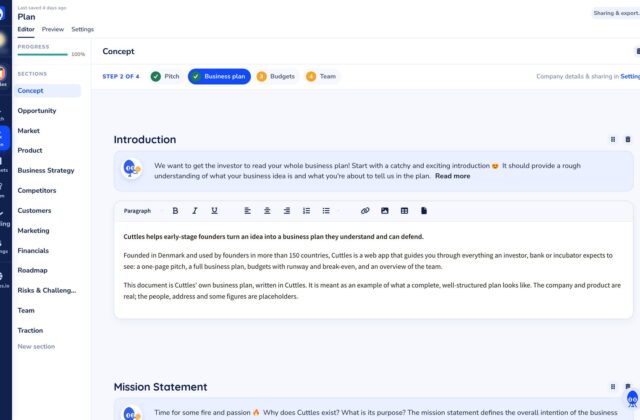
- 13 guided plan sections, each with an explanation and an example answer
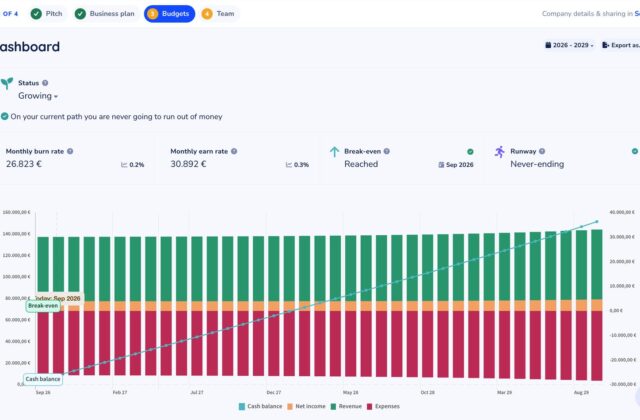
- A budget that calculates burn rate, runway and break-even and puts the charts in your plan
- Write in your own words, then tighten each field with [AI] Rewrite this or [AI] Polish
Can ChatGPT Write a Business Plan?
Yes, in the sense that it will produce a document with every heading a business plan should have. Type “write a business plan for a mobile dog grooming business in Austin” and you get an executive summary, a market analysis, a marketing plan and a three-year forecast. For a first look at what a plan contains, that is useful.
The trouble starts when you treat that output as your plan. ChatGPT is a general-purpose chatbot built on a large language model. It predicts plausible text from the prompt you give it and, depending on your settings and plan, from web search results. It does not know your rent, your supplier prices, what your first ten customers told you, or how many hours you can work before you need to hire. When it does not have a fact, it can fill the gap with something that sounds right. OpenAI’s own help center says ChatGPT can produce answers that are inaccurate or misleading, can sound confident when it is wrong, and advises users to verify important information such as data and references.
So the honest answer to “can ChatGPT write a business plan?” is: it can write a draft that looks like one. Turning that draft into a plan an investor, grant reviewer or co-founder can rely on is still your job, and the parts it cannot do are exactly the parts readers check first.
| Task | How well ChatGPT handles it | What you still do |
|---|---|---|
| Brainstorm names, angles, customer segments | Very well: fast, many options | Pick, and test with real people |
| Suggest an outline for a plan | Well: covers the standard sections | Cut sections that don’t fit your stage |
| Draft prose from your notes | Well, if the notes are specific | Check every claim it added |
| Explain a concept (TAM, gross margin, runway) | Well for common concepts | Confirm formulas against a reliable source |
| Critique a draft you wrote | Useful: finds gaps and vague sentences | Decide which criticism is right |
| Know your costs, customers and local market | No, unless you give it the facts | Gather the numbers yourself |
| Build financials that stay in step with the text | No: numbers in the chat are not linked to anything | Keep one source of truth for numbers |
A fair summary of where ChatGPT helps with a business plan, based on how the tool works and OpenAI’s own guidance on accuracy.

What ChatGPT Does Well in a Business Plan
Used as a sparring partner rather than an author, ChatGPT saves real time. These are the jobs where it earns its place.
Brainstorming before you commit
Early on, you want many options quickly: ten possible customer segments, five pricing models, twenty names. ChatGPT is good at this because volume matters more than accuracy at this stage. Nothing it suggests goes into the plan until you have checked it against the real world, ideally by talking to customers. Our guide on how to validate your idea covers that step.
Outlining and explaining
If you have never written a business plan, ChatGPT can explain what a SWOT analysis is, what goes in a market section or how gross margin differs from net margin, in plain words and with follow-up questions allowed. That is a patient tutor, and it is free to try. For standard definitions, cross-check against a source such as the U.S. Small Business Administration’s business plan guide, which describes the sections of a traditional plan and a lean startup plan.
Turning rough notes into readable prose
This is its strongest use. Paste in five bullet points you wrote after a customer interview and ask for a clear paragraph, and you usually get one. The key is that the facts come from you. Ask it to write from nothing and it invents; ask it to rewrite your notes and it mostly organizes.
Critiquing your draft
Paste in a section you wrote and ask what an investor would push back on. ChatGPT is good at spotting vague claims (“huge market”), missing information (no price, no competitor named) and sentences that say the same thing twice. You don’t have to accept every point, but a list of likely objections before a meeting is worth having.
Suggesting the questions you haven’t asked
Ask “what questions would a grant reviewer ask about this plan?” and you get a checklist you can work through. This is one of the least used and most useful prompts, because it points ChatGPT at your gaps instead of asking it to fill them.
Where ChatGPT Falls Short (and Why It Matters)
None of these limits make ChatGPT useless. They explain why a plan copied from a chat window tends to fall apart the first time someone asks “where does this number come from?”
It doesn’t know your business unless you tell it
Your actual costs, your customers’ words, your local competitors, the lease you are negotiating: none of that is in the model. If you don’t supply it, ChatGPT fills the section with typical-sounding content. A plan for a bakery in Portland and a bakery in Pittsburgh will read almost the same, and a reader who knows either city will notice.
Plausible numbers are not true numbers
Market sizes, average ticket prices, industry margins and growth rates are exactly the details a language model can get wrong while sounding certain. OpenAI tells users to verify data and references, and that applies doubly to anything you will put in front of an investor. Every figure in a ChatGPT draft needs a source you have opened yourself, or it needs to come out.
Its financials are not connected to its text
Ask for a three-year forecast and you get a table, perhaps even a spreadsheet file. But the number of customers in that table is not linked to the marketing section, the hiring plan or the funding ask. Change your price in one place and nothing else moves. Keeping every section consistent is entirely on you, and that is where most plans break: the market section says 5,000 customers, the forecast assumes 12,000, and nobody catches it until a reader does.
Long plans drift across chats
A full business plan is long, and most founders write it over days or weeks. Across several conversations, ChatGPT can lose track of what it said earlier, use a slightly different price in the revenue section, or rename your target customer halfway through. Pasting the whole plan back in each time helps, but it is manual work, and small inconsistencies still slip through.
Sources need checking
When ChatGPT cites a report or a statistic, open the link and confirm the page says what the answer claims. OpenAI’s help center notes the model may not be able to read some websites and can misstate what a source says. For a business plan, the rule is simple: if you have not seen the number on the source’s own page, it does not go in.
The plan sounds like everyone else’s
Readers who see many plans, such as accelerator staff and grant reviewers, recognize generic phrasing. “Innovative solution,” “passionate team” and “significant market opportunity” tell them the text was not written from experience. Your own specifics (a customer quote, a number from your pilot, the reason you left your job) are what make a plan credible.
Worked Example: Checking a ChatGPT Draft Against Real Numbers
Here is how the gap between a plausible draft and a real plan shows up in practice. Harbor Cart is a fictional coffee cart that plans to park outside a commuter rail station. The founder asked ChatGPT for a revenue forecast and got a confident answer. Then she stood at the station for five weekday mornings and counted.
ChatGPT draft: 180 cups a day at an average of $5.50, open 26 days a month. That is 180 × $5.50 = $990 a day, and $990 × 26 = $25,740 a month.
Founder’s count: about 1,200 commuters pass the spot each morning. In a week of test sales from a borrowed table, she sold an average of 90 drinks a day at an average of $5.00. That is 90 × $5.00 = $450 a day, and $450 × 26 = $11,700 a month.
The gap: $25,740 − $11,700 = $14,040 a month, about 55% less revenue than the draft assumed. Her fixed costs are $6,290 a month (cart lease, permits, insurance, her own pay) and supplies run at 30% of sales. On the draft, that leaves $25,740 − $6,290 − $7,722 = $11,728 a month. On her count, it leaves $11,700 − $6,290 − $3,510 = $1,900.
Nothing in the ChatGPT draft was absurd. A busy cart can sell 180 cups a day. It just wasn’t her cart, her station or her price. And because the draft’s marketing section was written around “180 daily customers,” she would have had to fix three sections, not one, to make the plan consistent. All figures here are illustrative, but the pattern is the one to watch for: a draft built on typical numbers, a real count that is lower, and several sections that quietly depend on the wrong figure.
To sanity-check a draft’s numbers, try the free break-even calculator with your own price and costs before you trust any forecast.
Free calculator: how many sales do you need to break even?
Your break-even point
Turn these numbers into a full business plan with budgets, runway and a pitch. 7-day free trial, plans from €8/month.
How to Use ChatGPT to Write a Business Plan: A 6-Step Workflow
If you are going to use ChatGPT, use it in an order that keeps your facts in charge. This workflow puts your own research first and uses the chatbot where it is strongest.
- Collect your factsCosts, prices, customer notes, competitors, in a plain document
- Get an outlineAsk for sections that fit your stage and reader
- Write each section yourselfRough bullets are fine, facts must be yours
- Ask for a clearer draftOne section at a time, with your notes pasted in
- Check every numberAgainst your budget and a source you have opened
- Ask for a critiqueWhat would a reader question, and what is missing
Step 5 is the one people skip. A good habit: keep your budget in a separate place (a spreadsheet, or the budget in a planning tool) and treat it as the only source for numbers. Any figure in the text that doesn’t match the budget gets fixed in the text, never the other way round.
ChatGPT Business Plan Prompts That Work
The prompts below are written to keep ChatGPT working from your facts. Replace everything in brackets. Each one asks the model to flag what it doesn’t know, which cuts down on invented details.
I am writing a business plan for [company name], a [type of business] in [city, country]. The main reader is [investor / grant reviewer / accelerator / my co-founder]. Our stage is [idea / pre-revenue / early revenue]. Here are my facts: [paste costs, prices, customer notes, competitors]. Use only these facts. When you need information I have not given you, ask me instead of assuming, and mark any estimate as [ESTIMATE].
Suggest a business plan outline for a [stage] startup whose reader is [reader]. For each section, write one line on what the reader wants to learn from it, and tell me which sections I can keep short at my stage.
Here are my notes for the [section name] section: [paste bullets]. Rewrite them as 150 to 250 words of plain prose in the second or first person plural. Do not add facts, numbers, names or claims that are not in my notes. List anything you would have liked to add as questions at the end.
Act as a skeptical seed investor reading this section: [paste section]. List the five questions you would ask, the claims you would not believe without evidence, and any sentence that is vague. Don’t rewrite it.
Here is my full plan: [paste plan]. Which questions would a [grant reviewer / accelerator / bank] ask that the plan does not answer? Rank them by how likely they are to be a deal-breaker.
Read this plan and list every number it contains (prices, customer counts, costs, dates, funding amounts) in a table with the section it appears in. Flag any number that appears with two different values. [paste plan]
My product is [one sentence]. Suggest eight specific customer segments who might buy it first. For each, give the problem they have, where I could find ten of them to interview this week, and one question to ask them.
List the types of alternatives a [customer] uses today to solve [problem], including doing nothing. Don’t name specific companies unless you are certain they exist and offer this; instead, tell me what to search for to find them myself.
Explain [burn rate / break-even / gross margin / TAM, SAM and SOM] in plain words, show the formula, then calculate it step by step with these numbers: [numbers]. Show every step so I can check the arithmetic.
Based on this plan [paste], list the five risks most likely to stop the business in its first 18 months. For each, suggest a response I could take and an early warning sign I could track.
Mark every sentence in this section that could appear in any company’s business plan, such as general claims about passion, innovation or market size without a number. For each, tell me what specific fact from my business would make it concrete. [paste section]
Using only the finished plan below, write a one-page summary covering the problem, solution, customer, market, business model, traction, team and what we are asking for. Keep every number exactly as it appears in the plan. [paste plan]
Prompts 4, 5, 6 and 11 are the ones worth running on every section, because they point ChatGPT at your weaknesses instead of asking it to cover them up. For the short summary at the end, our guides to the executive summary and the one-page business plan show what a good one contains.
ChatGPT vs Cuttles for a Business Plan
ChatGPT is a general assistant; Cuttles is software built for one job, getting a founder from idea to a finished business plan with a budget behind it. Here is how they compare on the things that decide whether a plan holds up.
| ChatGPT | Cuttles | |
|---|---|---|
| Structure | A blank chat; you decide the sections and the order | 13 guided plan sections, from Concept to Traction, each with an explanation and an example answer |
| Budget and financials that add up | Tables or spreadsheet files you check by hand | A multi-year budget that calculates burn rate, runway and break-even, and feeds the charts in your plan’s Financials section |
| Consistency across sections | Up to you, across one or many chats | One plan, one budget: change a number in the budget and the Financials charts update |
| Your own words | Tends to write for you unless you tell it not to | You write each field first, then use [AI] Rewrite this or [AI] Polish once per field, with “Revert to my text” if you prefer yours |
| Templates | Generic examples on request | 9 industry templates: complete sample plans with pitch, sections, SWOT, personas, competitors and a 3-year budget |
| Export and sharing | Copy text into a document and format it yourself | PDF with cover, table of contents, charts and page numbers, plus a live link (optional password) that always shows the latest version |
| Funding | General suggestions | Funding match (grants and investors matched to your plan) is coming to every yearly plan; the grants database and investor database are open now |
| Price | Free tier and paid plans (see OpenAI’s pricing page) | From €8/mo billed yearly, 7-day free trial |
ChatGPT features and prices change often; check openai.com for the current details. Cuttles prices as listed on the pricing page.
The two are not mutually exclusive. Plenty of founders brainstorm in ChatGPT and build the plan in Cuttles. What the comparison shows is where each belongs: a chatbot for thinking out loud, a structured tool for the document you will be judged on.
Why Cuttles for a Real Business Plan
A business plan is judged on two things: whether it answers the reader’s questions, and whether its numbers hold together. Cuttles is built around both.
Every section has a job and an example
The plan editor splits the plan into 13 sections: Concept, Opportunity, Market, Product, Business Strategy, Competitors, Customers, Marketing, Financials, Roadmap, Risks & Challenges, Team and Traction. Each field comes with a short guide explaining what the reader wants to learn, a “Read more” example answer, and a full example plan you can open next to your own. You never have to guess what goes in the Market Validation field or how long a Risks section should be.
The budget does the math and feeds the plan
In Cuttles, you enter expenses, revenue and capital as items (recurring or one-time, with start and end dates, growth and growth rate) and the budget dashboard shows monthly burn rate, monthly earn rate, the break-even month and runway. Those same charts appear in the Financials section of your plan automatically. When your price changes, you change it once in the budget and the plan shows the new picture. That is the consistency problem from the Harbor Cart example, solved by design rather than by rereading.

Your words, tightened, not replaced
Investors and grant reviewers want to hear the founder, not a template. In Cuttles, you write each field in your own words first. Then, on the Grow and Series plans, each field has two buttons: [AI] Rewrite this and [AI] Polish, one use of each per field. They work on the text you wrote, so the facts stay yours, and “Revert to my text” brings back your original if you liked it better.

Start from a finished plan in your industry
If a blank page is the problem, the Templates tab has 9 industry templates, such as a coffee shop, a restaurant, a food truck and a real estate agent. Each is a complete sample plan with a pitch, every plan section, a SWOT, personas, competitors and a 3-year budget. You copy it and replace the sample content with your own idea and numbers. You can preview some of them publicly under business plan templates.

Share it properly
When the plan is ready, share a live link that always shows the latest version (with an optional password), or export a PDF with a cover page, table of contents, charts and page numbers. There is also a one-page pitch view for a first email. Funding match, which matches grants and investors to your plan, is coming to every yearly plan. Until then, the public startup grants database lists 1,357 grants and the investor database lists 4,196 VCs, angel groups and accelerators.
Plans start at €8 a month billed yearly, with a 7-day free trial. See how it works for the four steps: pitch, business plan, budget and team.
Checklist: Before You Send a Plan That Started in ChatGPT
- Every number in the plan comes from your budget or a source you opened yourself.
- Prices, customer counts and costs are the same in every section (run Prompt 6 or check by hand).
- No statistic appears without a named source in a footnote or a sources list.
- Competitors named in the plan exist and offer what you say they offer.
- The customer section uses what real customers told you, not a generic persona.
- Generic phrases (“innovative,” “passionate,” “huge opportunity”) are replaced with specifics.
- The financial section shows the month when cash is lowest and what you will do about it.
- The summary was written last, from the finished plan.
- Someone who knows your industry has read it and found nothing that sounds borrowed.
For the full section-by-section method, read how to write a business plan, the business plan outline, or grab the free startup business plan template. If your plan needs a burn rate and runway figure, the guide to burn rate walks through the math.
Sources
- OpenAI Help Center, Does ChatGPT tell the truth? (accuracy, confidence and verifying data and references).
- U.S. Small Business Administration, Write your business plan (traditional and lean startup plan sections).
- OpenAI, ChatGPT pricing (current free and paid plans).
- Harbor Cart is a fictional company. All figures in the example are illustrative and calculated from the stated assumptions.
Let the chatbot help you think, and let your own numbers do the talking. — Cuttles