How to Write a Company Description for a Business Plan (With Examples)

The company description is usually the second thing a reader sees in your business plan, right after the summary, and it sets the tone for everything that follows. Most founders either write two vague lines or paste in their whole life story. This guide shows what actually belongs in a company description, gives you a fill-in template, and walks through three examples for fictional startups so you can see how the pieces fit together.
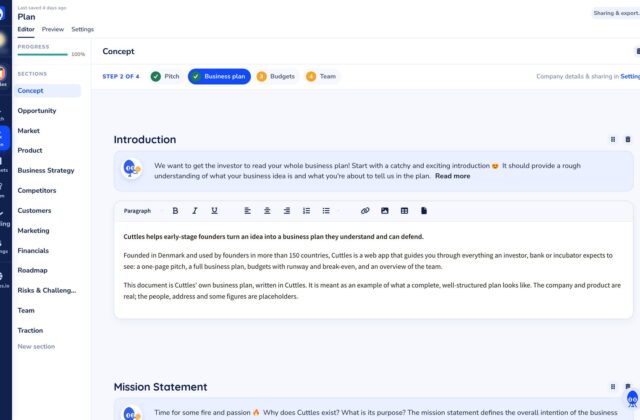
- A Concept section with Introduction, Mission Statement and Vision Statement, each with an explanation and example
- A full example plan you can open next to your own
- Write in your own words, then use [AI] Rewrite this or [AI] Polish on each field
What a Company Description Does in a Business Plan
A company description tells the reader, in one or two pages at most, who you are as a business: what you do, for whom, where, in what legal form, who owns it, how far you have come and where you are going. It is the factual foundation the rest of the plan builds on. If the market section describes 4,000 potential customers, the company description is where the reader learned which customers those are and why you are the one serving them.
The U.S. Small Business Administration’s guide to writing a business plan lists the company description as a core section of a traditional plan. It suggests going into detail about the problems your business solves, being specific about the consumers, organizations or businesses you plan to serve, and explaining the competitive advantages that will make the business a success, such as your team’s expertise or your location.
Readers use this section to answer three quiet questions:
- Is this a real business? A legal name, a structure, a location and an owner make it concrete.
- Do I understand what it does? One sentence should be enough for someone outside your industry.
- Why these people, now? The founders’ background and the timing explain why you might succeed where others haven’t.
Company description vs executive summary
People mix these up. The executive summary condenses the whole plan onto one page, including the market, the financials and what you are asking for. The company description is narrower: it describes the business itself. A good test is that your company description should still be accurate after you rewrite your forecast, while your summary would have to change.
| Company description | Executive summary | |
|---|---|---|
| Covers | Who you are, what you do, for whom, structure, ownership, history, mission | The whole plan: problem, market, model, traction, team, numbers, ask |
| When to write | Early, it frames every other section | Last, once everything else is final |
| Typical length | Half a page to two pages | One page |
| Numbers | Few: founding date, ownership split, funding to date | Many: market size, revenue, runway, amount raised |
A practical rule of thumb, not a formal standard. Some readers call the company description a “company overview”.

What to Include in a Company Description
Not every plan needs every element below, but most readers will look for the first six. Work through them in this order and you will have a complete draft.
- Name and one-linerWhat you do, for whom, in one sentence
- The problem you solveWho has it and what it costs them
- Customers and locationWhere you operate and who buys
- Legal structure and ownershipEntity type, founders, shares
- History and stageFounded when, milestones so far
- Mission and visionWhy you exist, where you are going
- Competitive advantageWhy you, specifically
1. Business name and a one-sentence description
Start with the legal name (and trade name, if different) and one sentence that says what you do for whom. Leave out adjectives. “Rise & Crumb is a neighborhood bakery in Columbus, Ohio, selling sourdough bread and pastries to walk-in customers and three local cafés” is better than “Rise & Crumb is an innovative artisan bakery concept.” If you have written a positioning statement, it is a good starting point.
2. The problem you solve
Two or three sentences on the problem, from the customer’s point of view. You will go deeper in the opportunity section, so keep it short here, but make it specific: who has the problem, how often, and what it costs them. Our guide to writing a problem statement has examples.
3. Customers, market and location
Name your first customer group and where you serve them. A local business names its neighborhood or city; an online business names its country or language and its customer type. If you sell to businesses, say which kind and what size. “Independent bookstores in the U.S. with one or two locations” is a customer group; “retailers” is not.
4. Legal structure and ownership
State the entity type (sole proprietorship, partnership, LLC, C corporation, S corporation or a nonprofit form) and where it is registered. The SBA’s guide to choosing a business structure explains how each one affects liability and taxes; the plan only needs to say which one you chose and, briefly, why. Then list who owns what, in percentages that add to 100. If you haven’t registered yet, say what you plan and when.
5. History, stage and milestones
When was the business founded, and what has happened since? At idea stage, that might be “12 customer interviews and a landing page with 340 sign-ups in six weeks.” With revenue, give the headline figures: customers, monthly revenue, growth. Keep this factual; the traction section is where you expand.
6. Mission and vision
The mission says why the company exists; the vision says what the world looks like if you succeed. One or two sentences each is plenty. See our guides to the mission statement and vision statement examples if you want more options.

7. Competitive advantage
Finish with the one or two reasons you will win: a founder with 10 years in the trade, an exclusive supplier, a location with foot traffic nobody else has, a technical approach competitors can’t copy quickly. Name it plainly. The competitor section will prove it; the company description only needs to claim it. For a structured way to find it, a SWOT analysis helps.
Company Description Template
Copy this skeleton, fill in every placeholder, then delete anything that doesn’t apply to your stage. The result is usually 250 to 450 words, which is about right for an early-stage plan.
Who we are. [Legal name] (trading as [brand name]) is a [type of business] based in [city, state/country]. We [what you do] for [specific customer group].
The problem. [Customer group] struggle with [problem], which costs them [time / money / risk, with a number if you have one]. Today they [current workaround], which falls short because [reason].
What we offer. Our [product or service] [how it solves the problem]. Customers pay [price and model].
Structure and ownership. [Company] is a [entity type] registered in [state/country] in [month, year]. It is owned by [founder A, %] and [founder B, %].
Where we are. Since [start date], we have [milestones: customers, revenue, pilots, sign-ups]. We are currently [stage] and [funding to date or funding sought].
Mission and vision. Our mission is to [why you exist]. In [number] years, we want to [vision].
Why us. [One or two specific advantages: experience, location, supplier, technology, relationships].
3 Company Description Examples
The three companies below are fictional, and all figures are illustrative. They cover a local business, a software startup and a service business, because the emphasis changes with the type of company. Read the notes under each to see what the description is doing.
Example 1: A neighborhood bakery
Rise & Crumb LLC is a neighborhood bakery in north Columbus, Ohio. We bake naturally leavened sourdough bread, laminated pastries and a small lunch menu, sold over the counter six days a week and wholesale to three independent cafés within two miles.
Within walking distance of our site, no bakery bakes bread from scratch. Residents who want it drive 20 minutes downtown or buy par-baked loaves at the supermarket. At a farmers market stall we ran for 14 Saturdays, we sold out every week and collected 610 email addresses from customers asking when we would open a shop.
Rise & Crumb was registered as an Ohio limited liability company in March 2026. It is owned by head baker Dana Ortiz (60%), who spent eight years in restaurant kitchens including four as a pastry lead, and operations partner Sam Keller (40%), who ran a café for five years. We have signed a five-year lease on a 1,400 sq ft former deli with a working hood and plan to open in February 2027.
The owners are putting in $40,000 and we are raising $45,000 from two local investors, for $85,000 in total: $38,000 for a deck oven, mixer and refrigeration, $22,000 for the buildout, $7,000 for permits and deposits, $6,000 for opening stock and $12,000 as working capital.
Our mission is to make good bread an everyday purchase in our neighborhood, not a weekend trip. Within three years, we want to supply ten cafés and restaurants in north Columbus from the same kitchen.
What it does well: the location is specific down to the neighborhood, the problem is backed by the market stall evidence, ownership adds up to 100%, and the funding line adds up too: $40,000 + $45,000 = $85,000, and $38,000 + $22,000 + $7,000 + $6,000 + $12,000 = $85,000. A reader can check every figure against the financial section, which is exactly what you want. If you are planning a similar business, the free startup cost calculator helps you build the use-of-funds list.
Example 2: A B2B software startup
Shelfwise Inc. makes inventory and reordering software for independent bookstores in the United States with one or two locations. Stores connect their point-of-sale system, and Shelfwise suggests what to reorder each week based on what sold, what is on order and what the publisher’s discount is.
Most small bookstores still reorder from memory or a spreadsheet. The owners we interviewed spend three to five hours a week on it, and all 18 said they regularly run out of books that sell well while returning books that don’t.
Shelfwise was incorporated as a Delaware C corporation in January 2026 by Priya Raman (CEO, 45%), a former bookstore manager, and Leo Marsh (CTO, 45%), who built inventory tools for a grocery chain; 10% is reserved for an employee option pool. We ran a free pilot with 11 stores from April to July and converted 9 to our $79 per month plan, for $711 in monthly recurring revenue. We are raising a $350,000 pre-seed round to reach 150 paying stores.
Our mission is to give independent bookstores the stock control that big chains take for granted. Our vision is for Shelfwise to become the default back office for independent retail, starting with books.
What it does well: the customer is narrow (independent bookstores with one or two locations), the traction is stated in numbers that check out (9 × $79 = $711), and ownership adds to 100% including the option pool. The founders’ backgrounds are one line each and directly relevant. Note that it does not try to size the market; that belongs in the market analysis.
Example 3: A home service business
Evergreen Gutter & Roof Care is a sole proprietorship owned by Marcus Bell, cleaning and repairing gutters for homeowners in Tacoma, Washington. The business offers one-off cleanings and a twice-yearly maintenance plan at $240 a year.
Tacoma’s rainfall means blocked gutters cause water damage every fall and spring, and most homeowners don’t want to climb a ladder. Larger roofing companies quote cleanings as a side job and are hard to book in peak season.
Marcus started the business in 2024 after six years with a roofing contractor. In 2025 he completed 380 jobs and signed 95 homeowners to the maintenance plan, which alone brings in 95 × $240 = $22,800 a year. He plans to convert to an LLC and hire one seasonal helper in 2027.
The mission is simple: no customer of ours should have water in their basement because of a gutter. The vision is to be the maintenance plan most Tacoma homeowners have for the outside of their house.
What it does well: it is short, honest about the structure (a sole proprietorship today, with a planned change), and the recurring revenue figure is calculated in plain view. For a small service business, that is often all a reader needs from this section.
How to Write a Company Description Step by Step
The template gives you the parts. This is the process that gets you from a blank page to a finished section in an afternoon.
Step 1: Write the one-liner first
If you can’t describe the business in one sentence, the rest of the description will wander. Write five versions, read them aloud to someone who doesn’t know the business, and keep the one they can repeat back correctly.
Step 2: Collect the facts before you write prose
List the hard facts in bullets: legal name, entity type, registration date, address, founders and percentages, milestones with dates and numbers, funding to date. This keeps the description factual and stops you from padding.
Step 3: Write for the specific reader
An investor cares about ownership, the founders’ fit and the size of the ambition. A grant reviewer cares about the mission and the local impact. A landlord or supplier wants to know you are real and stable. Keep the same facts but adjust which ones you lead with. The startup grants database shows grants by country with amounts, deadlines and who can apply, which is worth checking before you write.
Step 4: Cut every sentence that could describe any company
“We are passionate about quality” and “our team is dedicated to excellence” fit every business on earth. Replace them with a fact: “Dana spent eight years in restaurant kitchens.” If you cannot find a fact to replace a sentence, delete it.
Step 5: Check it against the rest of the plan
The customer group, the price, the location and the funding figures in your company description must match the market, product and financial sections word for word. This is the most common mistake in plans written over several weeks: the description says “cafés in north Columbus” and the marketing section talks about “restaurants across Ohio.”
Common Company Description Mistakes
- Starting with the founder’s life story. Background belongs here, but as one or two relevant lines per founder, not three paragraphs. The team section has room for more.
- Describing a category, not a company. “We operate in the fast-growing pet care industry” tells the reader about the industry. Say what you do.
- Ownership that doesn’t add up. Percentages must total 100, including any option pool or investor stake. A reader who spots 55% + 50% stops trusting the rest.
- Vague stage. “Early stage” means nothing. “Pre-revenue, 12 customer interviews and a signed letter of intent from one café” means a lot.
- Mission statements that could be anyone’s. “To deliver value to our customers” is not a mission. Say why this company exists.
- Market sizing in the wrong place. Keep TAM, SAM and SOM for the market section, and keep this section about the company.
Writing Your Company Description in Cuttles
Cuttles doesn’t have a field literally called “company description”. It splits the same content across the Concept section, which opens every plan, and the sections that follow:
| Company description element | Where it goes in Cuttles |
|---|---|
| Name, one-liner, what you do | Concept: Introduction |
| Why you exist | Concept: Mission Statement |
| Where you are going | Concept: Vision Statement |
| The problem you solve | Opportunity: Problem |
| Competitive advantage | Opportunity: Unique Value Proposition, and Competitors: Competitive Advantages |
| Founders and ownership | Team, with roles and short bios |
| History and milestones | Traction, and Roadmap for what comes next |
| Funding and use of funds | Budgets (Capital tab), shown in the plan’s Financials section |
Company details such as contact information and website are set once in Settings and appear on the plan’s cover page.
Each field has a short guide and a “Read more” example, and there is a full example plan you can open alongside yours. Write your Introduction, Mission Statement and Vision Statement in your own words first. On the Grow and Series plans, each field then has one [AI] Rewrite this and one [AI] Polish to tighten the wording, with “Revert to my text” if you prefer your version. If you are starting in food and drink, real estate, beauty, trades or transport, the Templates tab has 9 complete industry sample plans to copy and rewrite, and some are previewed publicly under business plan templates.
Company Description Checklist
- The first sentence says what you do, for whom and where, without adjectives.
- The problem names a specific customer group and what the problem costs them.
- Legal name, entity type and state or country of registration are stated (or planned, with a date).
- Ownership percentages are listed and add up to 100.
- Stage and milestones are stated in numbers and dates.
- Mission and vision are one or two sentences each and specific to your company.
- At least one competitive advantage is a fact, not a claim.
- Every figure matches the market, product and financial sections.
- No market sizing, no detailed forecast (those have their own sections).
- It fits on one page, or two at most.
Once your description is done, move on to the rest of the plan with our guide on how to write a business plan, or see the whole structure in the business plan outline.
Sources
- U.S. Small Business Administration, Write your business plan (what goes in the company description of a traditional plan).
- U.S. Small Business Administration, Choose a business structure (entity types and how they affect liability and taxes).
- Rise & Crumb, Shelfwise and Evergreen Gutter & Roof Care are fictional companies. All figures in the examples are illustrative and calculated from the stated assumptions.
Say what you do, for whom, and why you; the rest of the plan will have something solid to stand on. — Cuttles