Unique Value Proposition: How to Write One (With 12 Examples)

Most first-draft value propositions could belong to any company in the category: “fast, affordable, easy to use.” A reader learns nothing, and neither does the founder. A unique value proposition does one job: it tells a specific customer why to pick you over the thing they use today. This guide gives you a formula, a six-step method with a worked example, 12 examples and a checklist to test your own.
- A guided Unique Value Proposition field in the pitch builder, with an explanation and example
- An Opportunity section where problem, solution and UVP sit side by side
- [AI] Rewrite this and [AI] Polish to tighten the text you wrote yourself
What a Unique Value Proposition Is
A unique value proposition (UVP) is a short statement of the outcome a specific customer gets from your product, and why they get it from you rather than from the alternatives. It has three parts:
- Customer: who it is for. Not “everyone”, but the group you described in your problem statement.
- Outcome: what gets better for them, in their terms: time saved, money saved, risk removed, a result they want.
- Difference: what you do that the alternatives do not, and that makes the outcome believable.
“Value proposition” on its own describes the value you offer. The “unique” part is what makes it useful: the reason a customer who already has options would switch. A statement that a competitor could put on their own homepage without changing a word is a value proposition, but not a unique one.
It is also not your slogan, your mission or your feature list. Slogans are written to be remembered. A mission describes why the company exists, and a feature list describes the product. The UVP is the bridge from the customer’s problem to your product, and it is usually the headline on your website, the first line of your pitch and a key section of your business plan.

A Simple Formula and Template
Steve Blank, who helped shape the lean startup method, suggests a plain format for a first draft: “We help X do Y by doing Z.” It forces you to name the customer, the outcome and the mechanism in one sentence.
For a website, a pitch or a plan, expand it into three layers:
Headline (the outcome): [What the customer gets, in under 10 words]
Sub-headline (who and how): [Product] helps [specific customer] [outcome] by [the one thing you do differently], unlike [main alternative], which [where it falls short].
Proof points (three): [a number], [a feature that makes the difference possible], [evidence: customers, results, a guarantee]
The “unlike” clause is the part most founders leave out and the one that makes the proposition unique. You do not have to publish it (many companies do not name competitors on their homepage), but you should write it down, because it tells you whether you actually have a difference.
How to Write a Value Proposition in 6 Steps
- Start from the problemOne customer, one costly problem
- List the alternativesIncluding doing nothing
- Find your differenceWhat only you do, or do much better
- Translate to outcomeFeature, then benefit, then result
- Quantify itHours, dollars, days
- Write, cut, testFormula first, then read it to customers
We will walk through the steps with Ledgerline, a fictional bookkeeping service for independent restaurants. The numbers are illustrative, but the arithmetic holds so you can swap in your own.
Step 1: Start from the problem
A value proposition is an answer, so write the question first. Ledgerline’s problem statement: owners of independent restaurants get their monthly numbers around the 20th of the following month, too late to fix food costs that drifted, and they spend about six hours a month sorting receipts and supplier invoices for their bookkeeper.
Step 2: List the alternatives
What does the customer use today? Ledgerline’s interviewees used a general bookkeeper (about $400 a month, books closed around the 20th), did it themselves in accounting software in the evenings, or had their accountant sort everything once a year at tax time. Doing nothing counts as an alternative: it is free, which is why your outcome has to be worth more than your price.
Step 3: Find your difference
Look for something you do that the alternatives do not, and that customers care about. Ledgerline connects to the restaurant’s point-of-sale system and its main food suppliers, so the books close by the fifth working day and food cost is reported every week instead of every month. A general bookkeeper can do the same work, but not that fast, because they do not specialize in restaurants.
A good test for a difference: would a customer notice if you took it away? Weekly food cost passes. “Friendly service” does not, because every alternative claims it.
Step 4: Translate features into outcomes
Customers buy results, not features. Work each feature through to what it changes for them:
| Feature | Benefit | Outcome for the owner |
|---|---|---|
| Point-of-sale and supplier connections | No receipts to sort | Six hours a month back |
| Books closed by the 5th working day | Numbers two weeks earlier | Time to act before the next month |
| Weekly food cost report | Sees drift within days | Catches a supplier price rise before it eats a month’s margin |
Step 5: Quantify the value
Put a number on the outcome and compare it with your price. Ledgerline charges a flat $450 a month, $50 more than a typical general bookkeeper in its interviews. If an owner values their time at $35 an hour, six hours saved is worth $210 a month (6 × $35). That is $160 a month more than the $50 price difference ($210 − $50), before counting the value of seeing food costs weekly.
| Ledgerline (illustrative) | Per month |
|---|---|
| Owner time saved (6 hours × $35) | $210 |
| Extra cost vs. general bookkeeper ($450 − $400) | −$50 |
| Net value before food cost savings | $160 |
The owner’s hourly value is an assumption; the interviews supplied the six hours and the $400 bookkeeper price.
Step 6: Write, cut and test
Fill in the formula first, then the three layers:
Formula: We help independent restaurant owners fix food costs before they eat the month’s margin, by closing their books in five days and reporting food cost every week.
Headline: Your restaurant’s numbers by the 5th, and food cost every week.
Sub-headline: Ledgerline is bookkeeping built for independent restaurants. We connect to your point of sale and suppliers, so you stop sorting receipts and see problems while you can still fix them. A general bookkeeper sends last month’s numbers around the 20th.
Proof points: Six hours a month back. Weekly food cost report. Flat $450 a month, no hourly billing.
Then read it to five people in your customer group and ask them to explain back what you do and why they would switch. If they repeat the headline in their own words, keep it. If they describe a different company, rewrite.
12 Value Proposition Examples
The first four examples come from public companies and describe how each one presented its offer in its own IPO filing with the SEC. We describe their positioning in our words rather than quoting marketing copy. The other eight are fictional startups written with the template above.
Examples from public companies
1. Warby Parker: try at home, pay less
In its 2021 IPO filing, Warby Parker described designer-quality prescription glasses starting at $95, including lenses, and a Home Try-On program: customers pick five frames online and try them at home for five days for free. The filing also describes its Buy a Pair, Give a Pair program. Why it works: it removes the two reasons people did not buy glasses online (price and not knowing how the frames would look) with a specific, checkable offer.
2. Duolingo: learn a language for free, in short daily lessons
Duolingo’s 2021 IPO filing states that anyone can use the app and complete its courses without paying, and describes lessons that are short, available on demand and built with game mechanics to keep people coming back. About 5% of monthly active users were paying subscribers as of March 31, 2021. Why it works: “free” removes the main barrier for casual learners, and the game-like format addresses the real problem with learning a language, which is sticking with it.
3. Lemonade: insurance with fast claims and a fixed fee
Lemonade’s 2020 IPO filing describes renters and homeowners insurance bought and claimed through an app, with claims handled by a chatbot that can pay some claims within seconds. It also describes a business model where the company typically keeps a fixed fee (25% of premiums at the time) and donates excess premiums to nonprofits chosen by customers through its annual Giveback. Why it works: it targets the part of insurance people dislike most, slow and adversarial claims, and explains why the company has less reason to deny them.
4. Chewy: pet supplies that arrive before you run out
In its 2019 IPO filing, Chewy highlights a wide product range, round-the-clock customer service and its Autoship subscription, which made up roughly 66% of net sales in fiscal 2018. Why it works: people buy pet food again and again, and the real problem is running out of it. Autoship makes the value proposition part of a routine, while the service commitment eases concerns about ordering from an online store rather than a local one.
Examples from startups (fictional)
5. FrontDesk Relay (dental call answering)
Every call gets picked up, and new patients are scheduled directly on your calendar. Our receptionists aren't like a message-taking answering service; they can view your schedule and set the appointment while the patient is still on the line. One flat monthly fee.
6. ShiftNest (restaurant scheduling)
Shift swaps approved in two taps, without the group chat. Built for independent restaurants with 20 to 40 hourly staff, by a former general manager. $79 a month, whether you have 20 staff or 40.
7. Pedal & Wrench (mobile bike repair)
Your bike serviced at your door, not gone for a week. A mechanic comes to your home or office, and $19 a month covers two tune-ups a year plus call-outs. Built for people who ride to work and cannot be without their bike in peak season.
8. SafePlate (meal plans for food allergies)
A week of dinners that are safe for every allergy in your house, planned in two minutes. Unlike recipe apps that filter one allergen at a time, SafePlate checks every ingredient against all of your family’s allergies at once, and builds the shopping list.
9. CertTrack (subcontractor compliance)
No subcontractor on site with an expired certificate. CertTrack collects insurance certificates and licenses from your subs, tracks the expiry dates and chases renewals by email, so your office manager stops keeping a spreadsheet of dates.
10. Loop & Leash (dog walking vest)
A calmer walk from day one. A no-pull vest designed with dog trainers, rated 4.8 by 610 owners, for $38. Unlike a head collar, it does not need weeks of getting used to.
11. FridgeWatch (vaccine fridge monitoring)
Know about a warm fridge at 3 a.m., not at 9. A sensor in each fridge texts the pharmacist if the temperature leaves the safe range, and keeps the log you would otherwise write by hand. Priced per fridge for independent pharmacies, not per hospital.
12. Ledgerline (restaurant bookkeeping)
Your restaurant’s numbers by the 5th, and food cost every week. Bookkeeping built for independent restaurants, connected to your point of sale and suppliers, for a flat $450 a month.
What the good examples share
- A named customer. “Independent restaurants”, “people who ride to work”, “pharmacists”. Nobody writes “businesses of all sizes”.
- A concrete outcome. Numbers by the 5th, a fridge alarm at 3 a.m., frames tried at home for five days.
- A mechanism that makes it believable. The receptionist sees the calendar; the sensor texts you; the subscription ships before you run out.
- An implied or explicit “unlike”. Message-taking services, recipe apps, head collars, a bookkeeper who closes on the 20th.
UVP, Value Proposition Canvas, Positioning Statement and Tagline
These terms overlap, and founders often write one when a reader asked for another. Here is how they differ:
| What it is | Who reads it | Ledgerline (fictional) | |
|---|---|---|---|
| Unique value proposition | The outcome and the difference, in customer language | Customers, investors | Your restaurant’s numbers by the 5th, and food cost every week. |
| Value proposition canvas | A worksheet mapping customer jobs, pains and gains to your product | Your team | Pains: late numbers, receipt sorting. Gains: catching food cost drift. |
| Positioning statement | An internal sentence naming target, category, benefit and competitor | Your team, marketers | For independent restaurant owners, Ledgerline is the bookkeeping service that closes the books in five days, unlike general bookkeepers. |
| Tagline | A short, memorable line for the brand | Everyone | Numbers while they still matter. |
The canvas is where you do the thinking, the UVP is what you say to customers, and the positioning statement keeps your team consistent. Our guides to the value proposition canvas and the positioning statement cover each in detail.
How to Test Your Value Proposition
A UVP is a guess until customers react to it. Four cheap ways to test it:
- Read it back. Read the UVP to five people in your customer group, then ask them to explain what you do and who it is for. If three of five get it right, it is clear. Steve Blank recommends a version of this: if they cannot repeat it, explain it longer and ask them to summarize it for you, then use their words.
- Swap the name. Put your main competitor’s name in front of your UVP. If it still reads as true, it is not unique yet.
- Landing page test. Put two versions of the headline on a simple page with a sign-up button and send the same kind of traffic to each. With small numbers the result is a hint, not proof, but a large difference is worth acting on.
- Sales calls. Open three calls with the UVP and write down the first question each prospect asks. If everyone asks “so what does it actually do?”, the outcome is too abstract.
Before you publish it, check it against this list:
- It names a specific customer group, the same one as your problem statement.
- The outcome is something the customer wants, in words they use.
- There is a number, a time frame or a concrete result where possible.
- The difference is true today, not on the roadmap.
- You can finish the sentence “unlike [alternative], which [falls short]”.
- A competitor could not put it on their homepage unchanged.
- The headline is under 10 words; the whole UVP reads in under 10 seconds.
- No buzzwords: innovative, platform, solution, next-generation, world-class.
- Five people in your customer group explained it back correctly.
Five Common UVP Mistakes
- Features instead of outcomes. “Cloud-based with 40 integrations” is a spec sheet. What does the customer get?
- Claiming what everyone claims. “Fast, affordable, easy to use” is the default setting of every product. If a claim is true for your competitors, it is not your difference.
- Targeting everyone. A UVP for “businesses and individuals” is written for nobody. Pick the customer from your market segmentation who needs you most.
- Promising what you cannot deliver. “Guaranteed results in 24 hours” will be tested by your first customer. Say what is true and let the numbers carry it.
- Never revisiting it. A difference erodes as competitors copy it. Check your UVP when a competitor launches something similar, and when you move into a new customer segment.
Where Your UVP Goes in the Pitch and the Plan
Your UVP appears in several places at different lengths. In the pitch and the deck, it is one or two lines right after the problem and solution. In the business plan, it sits in the opportunity part of the plan with the proof points, and it shapes your competitor section and your marketing. On your website, it is the headline and sub-headline.
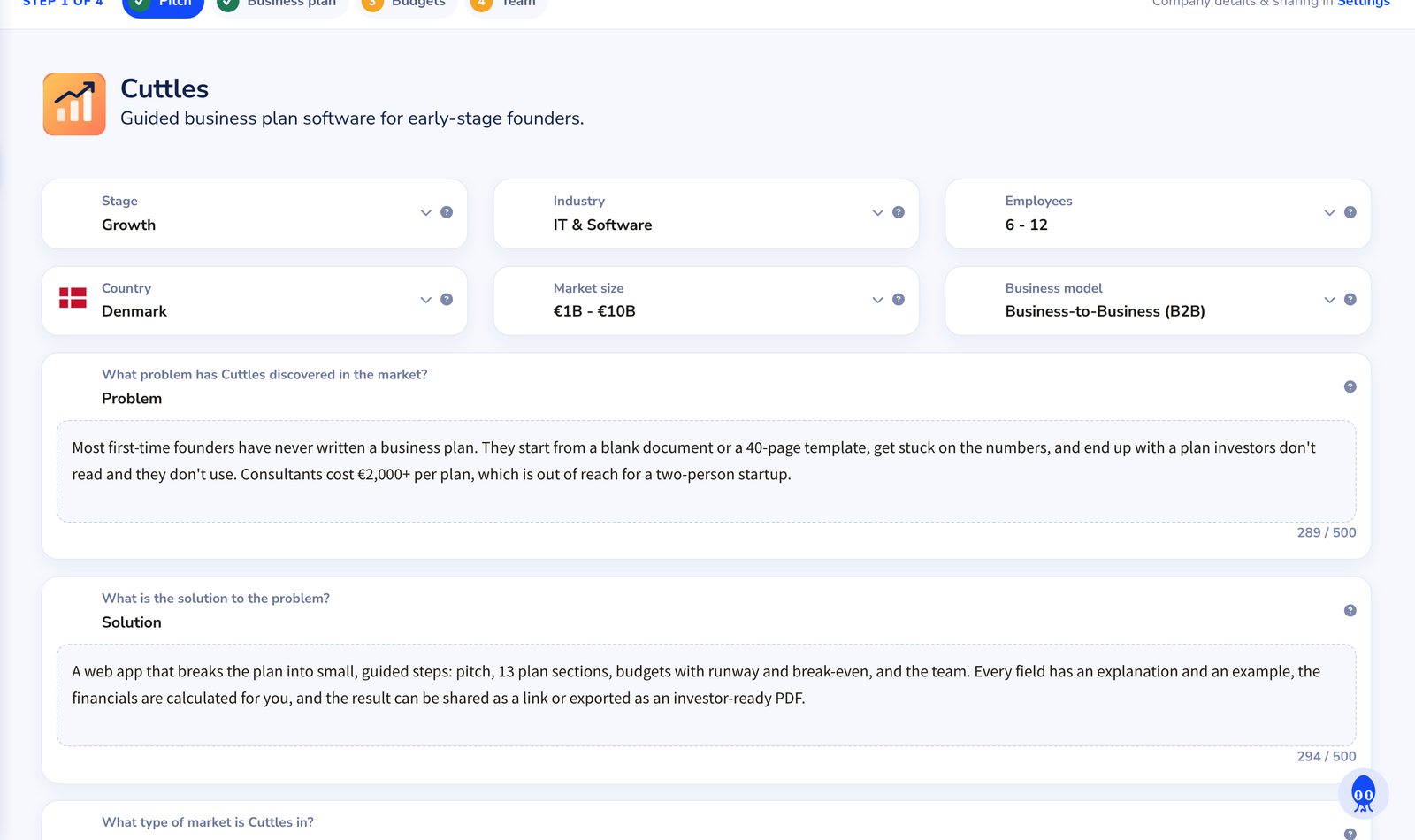
In Cuttles, the pitch builder has a guided Unique Value Proposition field next to Problem, Solution and Market, with an explanation of what to write, and the plan editor’s Opportunity section holds Problem, Solution and Unique Value Proposition together. The Marketing section has a Brand Positioning field for the positioning statement. Write the UVP in your own words first. On the Grow and Series plans, [AI] Rewrite this and [AI] Polish can tighten it, one of each per field, and “Revert to my text” restores your version.
If the difference in your UVP is price, run it past the free break-even calculator before you publish it. A value proposition built on being cheaper only works if the numbers still add up at that price. See Cuttles pricing for the plans with writing help.
Sources
- Steve Blank, How to Build a Web Startup: Lean LaunchPad Edition (the “We help X do Y by doing Z” format and testing it with others).
- Warby Parker Inc., Form S-1, 2021 (Home Try-On, starting price, Buy a Pair, Give a Pair).
- Duolingo, Inc., Form S-1, 2021 (free access, paid subscriber share).
- Lemonade, Inc., Form S-1/A, June 2020 (fixed fee, Giveback, claims).
- Chewy, Inc., Form S-1, 2019 (Autoship share of net sales, customer service).
- Ledgerline and the startups in examples 5 to 12 are fictional. Their figures are illustrative and calculated from the stated assumptions.
Say who it is for, what changes for them, and why nobody else does it quite like you. — Cuttles


