How to Write an Executive Summary for a Business Plan (With Examples)

The executive summary is the page an investor, grant reviewer or accelerator reads first, and often the only page they read before deciding whether to read on. That makes it the hardest page to write and the worst one to start with. This guide shows you how to write an executive summary from a finished plan, with a template and three complete examples from different kinds of startups.
- 13 guided plan sections, each with an explanation and an example answer
- A one-page pitch view that gives readers the short version of your plan
- [AI] Rewrite this and [AI] Polish to tighten a draft you have written yourself
What an Executive Summary for a Business Plan Must Contain
An executive summary is a one-page version of your business plan that can be read on its own. It is not an introduction that promises detail later. It states the conclusions: what the business does, for whom, why it will work, what the numbers are and what you are asking for. The writing center at the University of Maryland Global Campus describes it as a stand-alone document, roughly 10% of the length of the report it summarizes, and often the first and only part a decision maker reads.
The U.S. Small Business Administration lists what it expects in the executive summary of a traditional business plan: your mission statement, your product or service, and basic information about your leadership team, employees and location, plus financial information and high-level growth plans if you are asking for financing. For a startup, that translates into nine elements:
| Element | What to write | Length |
|---|---|---|
| One-line description | What the company does, for whom, in plain words | 1 sentence |
| Problem | Who has the problem and what it costs them today | 1 to 2 sentences |
| Solution | What you sell and why it solves that problem better than the alternatives | 1 to 2 sentences |
| Market | Your first customer segment, how many there are and what they are worth per year | 1 to 2 sentences |
| Business model | Price, how you charge, and the channel that brings customers in | 1 to 2 sentences |
| Traction | Evidence so far: revenue, pilots, sign-ups, letters of intent, interviews | 1 to 2 sentences |
| Team | Why these founders, in terms of relevant experience | 1 to 2 sentences |
| Financial highlights | Current revenue or burn, break-even month, the key number you will hit | 1 to 3 sentences |
| The ask | How much you need, what it pays for and the milestone it gets you to | 1 to 2 sentences |
Add the mission statement in a line if your reader expects it (many grant programs do). Keep it to one sentence.
That adds up to 250 to 500 words, which fits on one page with a heading and a little white space. If yours runs past a page, the problem is almost never the page. It is that some part of the plan is still undecided, and the summary is trying to cover every option at once.

How to Write an Executive Summary in 7 Steps
The order matters more than the wording. Write the rest of the business plan first, then build the summary out of it.
- Finish the planSummary comes last
- Pick the readerInvestor, grant, partner
- Pull one line per sectionThe conclusion, not the detail
- Write the opening lineWhat, for whom, why now
- Add the numbersMarket, traction, finances
- State the askAmount, use, milestone
- Cut and testOne page, stranger test
Step 1: Finish the rest of the plan first
A summary written first describes the business you hope to have. A summary written last describes the one you have worked out. If you write it first, you will rewrite it every time the market section, the price or the financials change, which is five or six times in a typical first plan. Write a one-sentence placeholder at the top and move on.
Step 2: Decide who is reading
For an angel investor, the priorities are the market, traction and the ask. Someone reviewing a grant looks for impact, eligibility and a budget that is easy to follow. A possible partner cares mainly about what they stand to gain. Across all of these, the nine elements remain constant; only their sequence and emphasis shift. Open with the point that particular reader will be screening for.
Step 3: Pull one sentence from each section
Go through your finished plan and write down the single most important conclusion from each section: the problem in one line, the market in one line, the price in one line. Do not summarize the argument. Summarize the answer. “Our customer interviews and survey suggest demand” is an argument. “Twenty-two of 30 practice managers we interviewed said they would pay $149 a month” is an answer.
Step 4: Write the opening sentence
The first line has one job: tell the reader what the company does and for whom, clearly enough that they can repeat it. Avoid adjectives. Compare “An innovative platform transforming patient engagement” with “Chairside fills cancelled dental appointments by texting patients on a waitlist.” Only the second tells the reader anything. If you have already written a mission statement or a unique value proposition, start from those.
Step 5: Add the numbers that matter
Pick three to five numbers and make sure each one matches the plan exactly: the size of your first market, your traction to date, your price, your monthly revenue or burn, and the month you expect to break even. Numbers that differ between the summary and the financials are the fastest way to lose a reader’s trust, and they appear most often when the summary is written in a different file from the budget.
Step 6: State the ask
End with what you want: an amount, what it will be spent on and what it gets you to. “We are raising $400,000 to reach 150 paying practices and break-even within 18 months” is a complete ask. “We are seeking investment to scale” is not. If you are applying for a grant, state the grant amount and your matching contribution, if the program requires one.
Step 7: Cut it to a page, then test it on a stranger
Remove every sentence that a reader would not miss. Then give the page to someone outside your industry and ask them to explain the business back to you in 30 seconds. If they cannot say who the customer is, what you sell and what you need, fix the summary before you send it anywhere.
Executive Summary Template
Fill in the brackets from your finished plan. The template follows the nine elements in the order most investors read them; move the traction paragraph higher if it is your strongest point.
[Company name] helps [specific customer] [do what / avoid what] by [how the product works, in one line].
Problem. [Customer] currently [workaround], which costs them [time, money or risk, with a number].
Solution. [Product] [what it does]. Unlike [main alternative], it [key difference].
Market. Our first market is [segment]: about [number] customers, worth [$ per year] at our price. [One line on why now].
Business model. We charge [price and model] and reach customers through [one or two channels].
Traction. [Revenue, customers, pilots, sign-ups or interviews, with numbers and dates].
Team. [Founder 1] [relevant experience]. [Founder 2] [relevant experience].
Financials. [Current monthly revenue or burn]. We expect to reach [milestone] by [month/year] and break even in [month/year].
The ask. We are raising [amount] to [two or three uses], which takes us to [milestone] by [date].
Three Executive Summary Examples
The three companies below are fictional, and every number is illustrative. They are written at three different stages so you can see how the weight shifts: an idea-stage software startup leans on validation, a local business on its costs and demand evidence, and an early-revenue company on its growth.
Example 1: Pre-seed software startup
Chairside fills cancelled dental appointments automatically by texting patients on a waitlist the moment a slot opens, so small practices stop losing chair time to last-minute cancellations.
Problem. In independent practices with one to three dentists, the front desk fills cancellations by phoning patients one by one. It takes time the desk does not have, so most same-day gaps stay empty.
Solution. Chairside connects to the practice’s calendar, offers the open slot by text to waitlisted patients in order, and books the first one who confirms. Unlike the reminder tools most practices already use, it fills the gap instead of only reminding patients about it.
Market. Our first market is small independent practices in five Midwest states: about 4,000 practices by our count from state licensing lists, worth $7.2 million a year at our price.
Business model. $149 per practice per month, sold directly to office managers through dental study clubs and a referral credit for existing customers.
Traction. 14 practices are in a paid pilot ($2,086 in monthly recurring revenue). In the pilot, practices filled 61% of cancelled slots through Chairside.
Team. Dana Ortiz ran the front desk of a three-dentist practice for nine years. Sam Lee built calendar integrations at a practice-management software company.
Financials and ask. We are raising $400,000 to fund 18 months at a planned burn of $22,000 a month. That pays for a second engineer and one salesperson, and gets us to 150 paying practices, $22,350 in monthly recurring revenue and break-even by month 18.
Why it works: every number connects. 150 practices at $149 is $22,350 a month, which covers the planned $22,000 burn, so the ask, the milestone and break-even are one story. 18 months at $22,000 is $396,000, which explains the $400,000 ask. The market figure is also built from the bottom up: 4,000 practices times $149 times 12 months.
Example 2: Local business before opening
Northside Bread Co. is a bakery café opening in a Minneapolis neighborhood with no bakery within a mile, selling bread, pastries and coffee to walk-in customers and bread wholesale to local cafés.
Problem and opportunity. The nearest bakery is a 20-minute walk from our block, which has two coffee shops that currently buy bread from a distributor. Both have told us they would switch to a local bakery with morning delivery.
Market and model. We plan for 180 customers a day at an average ticket of $9, 26 days a month, which is $42,120 a month from the café. Wholesale to six cafés adds $4,000 a month.
Traction. Our farmers market stall sold out in 11 of 14 weeks this summer. Three cafés have signed letters of intent for wholesale bread from opening day.
Team. Head baker Ana Kowalski spent eight years at two of the city’s busiest bakeries. Co-owner Tom Reyes managed a 40-seat café for five years and will run front of house and the books.
Financials. Opening costs are $150,000: $95,000 for ovens and fit-out, $15,000 for the lease deposit and first rent, $12,000 for opening stock and smallwares, and a $28,000 cash reserve. We expect to break even in month 9.
The ask. The owners are putting in $60,000. We are raising $90,000 from local investors for a 20% stake, to open in March.
Why it works: for a local business, the reader’s first question is whether the costs are real and whether the demand is local. The summary answers both with specifics: a costed opening budget that adds up to the $150,000 ($60,000 from the owners plus the $90,000 raise), and demand evidence from the same neighborhood. If you are working on a food business, our industry business plan examples include a coffee shop, a restaurant and a food truck.
Example 3: Early-revenue consumer startup
Loop & Leash sells dog shampoo by subscription in a refillable aluminum bottle, with concentrated refills mailed every month in a letterbox-sized pouch.
Problem. Dog owners who bathe their dog often go through a plastic bottle every few weeks, and the brands sold in pet stores come in single-use packaging.
Solution and model. A $15 monthly refill subscription, sold online. After the first order, customers only receive the pouch, which lowers our shipping cost per order.
Traction. 1,200 active subscribers and $18,000 in monthly recurring revenue after 14 months. Subscribers have grown 9% a month for the last six months. Monthly churn is 4%, customer acquisition cost is $32, and gross margin is 64%.
Team. Priya Nair led growth at a pet food subscription brand. Marco Silva formulated personal care products for a contract manufacturer for seven years.
The ask. We are raising $750,000 to add two retail partners, launch a conditioner refill and grow to 5,000 subscribers and $75,000 in monthly recurring revenue within 20 months.
Why it works: with real revenue, the numbers do the persuading, so the summary puts them in one dense line and does not dress them up. 1,200 subscribers at $15 is $18,000 a month; 5,000 at $15 is $75,000. The reader can check both in their head, and the churn and acquisition cost show the founders know which numbers an investor will ask about next.
One-Page Summary vs Executive Summary Slide
The same content appears in two formats, and they are written differently.
| One-page executive summary | Executive summary slide | |
|---|---|---|
| Where it is used | First page of the business plan, sent on its own by email, attached to applications | Opening or closing slide of a pitch deck, or the first slide of a board or partner update |
| Length | 250 to 500 words | 30 to 60 words, in 4 to 6 short lines |
| Reads without you | Yes, it must | Usually no, you are presenting it |
| Content | All nine elements | One-liner, one traction number, one market number, the ask |
For a slide, write one line per point and let the numbers stand alone. For Chairside, it would be: “Fills cancelled dental appointments by text · 14 paying pilot practices · 61% of cancellations filled · 4,000 practices in launch states · Raising $400,000 to reach 150 practices and break-even.” Our pitch deck guide shows where that slide fits in a full deck.
There is a third, even shorter version: the two or three sentences in the body of an email. Take the one-liner, the strongest traction number and the ask from your summary, and attach the full page.
Writing the Summary in Cuttles
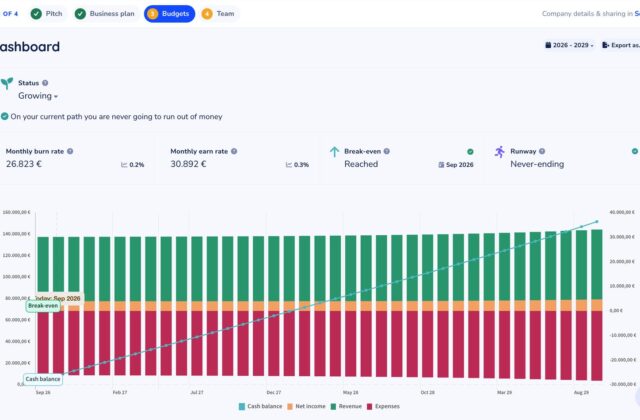
To be clear about how the app is set up: Cuttles has no separate section called “Executive summary.” The plan opens with the Concept section, and its Introduction field is where your opening summary goes, followed by the Mission Statement and Vision Statement. Because Concept is the first section, the Introduction is the first section text readers reach in the shared plan and the PDF. The one-page pitch view is the short version of your plan that you can share on its own.
The practical workflow follows the steps above. Work through the other 12 sections first, from Opportunity to Traction, and build the budget so the Financials section has real runway, expense, revenue and capital charts. Then come back to Concept and write the Introduction from what is already in the plan, using the template above.

On the Grow and Series plans, each field has an [AI] Rewrite this button and an [AI] Polish button, one of each per field. Both work on text you have already written and tighten it, and “Revert to my text” restores your own version if you prefer it. They will not invent traction or numbers for you, which is the point: the facts in a summary have to come from you.

When you share the plan as a live link, readers always see the latest version, so a corrected number in the summary does not require sending a new file. Cuttles plans start at €8 a month on a yearly plan, with a 7-day free trial; see pricing.
Executive Summary Checklist
- It fits on one page, and it makes sense without the rest of the plan.
- The first sentence says what you do and for whom, with no adjectives doing the work.
- The problem names a specific customer and what the problem costs them.
- The market figure is your first segment, built from customers times price.
- Price and business model are stated as numbers, not described.
- Traction is specific: counts, amounts and dates, or interview numbers at idea stage.
- Each founder gets one line of relevant experience, not a job title.
- Every number matches the financial section and the budget exactly.
- The ask states an amount, what it pays for and the milestone it reaches.
- A reader outside your industry can repeat the business back to you after one read.
Six Executive Summary Mistakes
- Writing it first. You summarize a business that does not exist yet and rewrite the page every time the plan changes.
- A teaser instead of a summary. “Read on to discover our unique approach” wastes a line. State the approach.
- Top-down market numbers. “A $40 billion pet market” says nothing about your customers. Give the segment you will actually sell to. Our guide to bottom-up market sizing shows how.
- No ask. Readers finish the page not knowing what you want from them. Put the amount and the milestone in the last paragraph.
- Numbers that disagree with the plan. A summary that says 150 customers and a forecast that says 200 makes the reader doubt both.
- Two pages. If it does not fit on one page, cut the explanations, not the numbers.
Once the summary is done, the one-page business plan is the natural next format: same facts, laid out as a grid instead of prose. And if you are sending the plan to funders, the startup grants database shows grants by country with amounts, deadlines and who can apply, so you can shape the summary for that reader.
Sources
- U.S. Small Business Administration, Write your business plan (contents of the executive summary in a traditional plan).
- University of Maryland Global Campus Effective Writing Center, Executive Summary (stand-alone document, about 10% of the length of the full report).
- Chairside, Northside Bread Co. and Loop & Leash are fictional companies. All figures in the examples are illustrative and calculated from the stated assumptions.
Write it last, keep it to a page, and make every number one the reader can check. — Cuttles