One-Page Business Plan: Template and Example You Can Finish Today

A one-page business plan forces the decisions a 30-page plan lets you postpone. There is no room for a paragraph on market trends, so you have to say who buys, at what price, and how many customers you need to cover your costs. This guide gives you a 12-box template, a complete example for a fictional pottery studio with numbers that add up, and a method to fill in your own in about an hour.
- A pitch builder with guided fields for problem, solution, market, business model, customers, channels, competitors, team and traction
- A one-page pitch view you can share as a live link or a PDF
- The same answers grow into a full 13-section business plan when you need one
What a One-Page Business Plan Is For
A one-page business plan is a summary of your whole business on a single page: the problem, the solution, the customer, how you make money, the key numbers and what you need next. It is not a shortened version of a long plan. It is a different tool, built for speed and clarity.
The U.S. Small Business Administration describes this format as a lean startup plan: high-level, fast to write, and typically only one page, taking as little as an hour to make. The SBA contrasts it with a traditional plan, which covers every section in detail and is more often what banks and some investors ask for.
Founders use a one-page plan in four situations:
- Testing an idea. If you cannot fill all 12 boxes, you have found the gaps before spending a month on a full plan. Our guide on how to validate your idea covers what to do with the gaps.
- First contact. A first email to an investor, mentor, accelerator or potential co-founder. Nobody reads 30 pages from a stranger. One page gets read.
- Aligning a founding team. Two founders who fill in the page separately and then compare usually discover at least one real disagreement, often about the customer or the price.
- Running the business. One page on the wall is easier to check decisions against than a document in a folder.
One-Page Business Plan Template
The template has 12 boxes. On paper or in a document, lay them out as a grid of three columns and four rows. Each box gets one to three short sentences or a few numbers. If a box needs more, you have not decided yet what the answer is.
| # | Box | What to write | Length |
|---|---|---|---|
| 1 | Business and one-liner | Name, location, and what you do in one sentence | 1 sentence |
| 2 | Problem | Who has the problem, and what it costs them today | 1 to 2 sentences |
| 3 | Solution | What you sell and how it fixes the problem | 1 to 2 sentences |
| 4 | Target customer | Your first customer group, described precisely | 1 sentence |
| 5 | Alternatives | What customers use today, including doing nothing | 2 to 4 items |
| 6 | Why us | Your unique value proposition: why a customer picks you over the alternatives | 1 sentence |
| 7 | Revenue model and price | What customers pay, how often, and for what | 1 to 3 prices |
| 8 | Channels | How your first customers will find you | 2 to 3 channels |
| 9 | Key numbers | Startup costs, monthly fixed costs, break-even point | 3 to 5 numbers |
| 10 | Milestones | What happens in the next 12 months, with dates | 3 to 5 milestones |
| 11 | Team and traction | Who runs it, and the evidence so far | 2 to 3 lines |
| 12 | What we need | Money, people or partners, and what it pays for | 1 to 2 sentences |
Boxes 1 to 6 describe the opportunity, 7 to 9 the economics, 10 to 12 the plan and the ask.
If you prefer to write in sentences rather than boxes, use this fill-in version. It covers the same 12 points and fits on one page at a normal font size.
[Business name] is a [type of business] in [location] that [what you do, one line].
[Target customer] struggle with [problem], which costs them [time, money or risk]. Today they use [alternatives], which fall short because [reason].
We offer [solution]. Customers choose us because [unique value].
We charge [price and model] and reach customers through [channels].
We need [startup costs] to open. Fixed costs are [amount] a month, so we break even at [number] customers.
In the next 12 months we will [milestones with dates]. The team is [names and relevant experience], and so far we have [traction].
We are looking for [amount or resource] to [what it pays for].
One-Page Business Plan Example
Kiln Street Studio is a fictional pottery studio in Portland, Oregon, offering monthly memberships and beginner courses. The numbers are illustrative, but every figure is calculated from the stated assumptions, so you can check how box 9 is built.
| Box | Kiln Street Studio |
|---|---|
| 1. Business | Kiln Street Studio, Portland, OR. A membership pottery studio where adults who have taken a beginner class can keep throwing without buying a wheel and a kiln. |
| 2. Problem | People finish a six-week pottery course and then have nowhere to practice. Home setups need a wheel, a kiln and ventilation, and cost thousands of dollars. |
| 3. Solution | A studio with 10 wheels and 2 kilns, open 7 a.m. to 10 p.m. Members book wheel time online, store work on their own shelf and get their pieces fired weekly. |
| 4. Target customer | Adults aged 25 to 55 within a 15-minute drive who have finished at least one beginner course. |
| 5. Alternatives | Community center classes (cheap, but fixed times and long waiting lists); private studios (few open memberships); a home setup (expensive, no space); stopping altogether. |
| 6. Why us | The only studio in the area with bookable wheel time 15 hours a day, so members can practice around a full-time job. |
| 7. Revenue and price | Membership $160 a month (clay, glazes and firing included). Six-week beginner course $240, which also feeds new members. |
| 8. Channels | Beginner courses that convert graduates into members; Instagram posts of member work; a referral month free for members who bring a friend. |
| 9. Key numbers | Startup costs $48,000. Fixed costs $9,600 a month. Each member costs $25 a month in clay, glaze and firing, so contributes $135. Break-even: 72 members. |
| 10. Milestones | Lease signed March; studio open June; 40 members by September; 75 members by March next year; second kiln room by the end of year two. |
| 11. Team and traction | Ana (ceramicist, 9 years teaching) and Jon (ran operations at a climbing gym). Three sold-out pop-up workshops; 85 people on the waiting list. |
| 12. What we need | $30,000 alongside $30,000 of founder savings: $48,000 for setup and $12,000 as an operating buffer for the first months. |
Kiln Street Studio, its founders and its traction are fictional. Break-even counts memberships only; course revenue is extra.
Here is how the numbers in box 9 and box 12 are built, so you can do the same for your own business:
Startup costs ($48,000): 2 kilns at $6,500 ($13,000), 10 wheels at $900 ($9,000), build-out for ventilation, sinks and shelving ($12,000), a rent deposit of two months at $4,200 ($8,400), and tools, first clay stock, website, legal and insurance ($5,600).
Monthly fixed costs ($9,600): rent $4,200, part-time instructors $3,600, utilities including kiln power $900, insurance $300, software and marketing $600.
Break-even: $160 membership − $25 materials and firing = $135 per member. $9,600 ÷ $135 = 71.1, so 72 members.
Funding: $30,000 founder savings + $30,000 raised = $60,000. That covers the $48,000 setup and leaves $12,000, a little over one month of fixed costs, as a buffer.
Reading the page, an experienced reader would ask two things straight away. First, the gap between 40 members in September and 72 at break-even: the studio loses money every month until then, and a $12,000 buffer does not go far at $9,600 of fixed costs. Second, the course revenue: if beginner courses bring in real money, including them would bring break-even closer. Both questions are good news for the founders. They show the page works: it puts the real issues on the table in 60 seconds of reading. The free break-even calculator runs the same numbers for your business.
Free calculator: your break-even point
Your break-even point
Turn these numbers into a full business plan with budgets, runway and a pitch. 7-day free trial, plans from €8/month.
How to Write Your One-Page Plan in 60 Minutes
Set a timer for each block. The limit is the point: it stops you polishing box 3 while box 9 is still empty.
- 10 min: problem and customerBoxes 2 and 4
- 10 min: solution and why usBoxes 3, 5 and 6
- 15 min: moneyBoxes 7 and 9
- 10 min: channels and milestonesBoxes 8 and 10
- 5 min: team, traction, askBoxes 11 and 12
- 10 min: one-liner and cutBox 1 last, then trim
Minutes 0 to 20: the opportunity
Start with the problem and the customer, not your product. Write who has the problem so precisely that you could find ten of them this week. Then write your solution as a reply to that exact problem, list the alternatives, and finish with one sentence on why a customer would switch. If you get stuck, our guides to the problem statement and the unique value proposition have fill-in formulas.
Minutes 20 to 35: the money
This is the block founders skip, and the one readers look at first. You need three numbers: startup costs, monthly fixed costs and a break-even point. Rough is fine. The startup cost calculator helps with the first. For the break-even point, use the formula:
Minutes 35 to 50: channels, milestones, team and ask
Pick two or three channels you can start this month, not ten you might try one day. Write milestones with a month next to each. For the ask, state an amount and what it pays for. If you are not raising money, write what you need instead: a co-founder, a first pilot customer, a supplier.
Minutes 50 to 60: the one-liner, then cut
Write box 1 last, when you know what the business is. Then read the page out loud and cut every word that does not add a fact. If it runs over one page, shrink the longest box, not the font.
One-Page Plan, Lean Business Plan or Full Plan?
The terms overlap. “Lean business plan” usually means a short plan built around the nine blocks of the Business Model Canvas, which is the version the SBA describes: key partnerships, key activities, key resources, value proposition, customer relationships, customer segments, channels, cost structure and revenue streams. A one-page plan like the template above covers most of the same ground but adds the parts a reader outside your team needs: key numbers, milestones, team and the ask.
| One-page plan | Lean plan (Business Model Canvas) | Full business plan | |
|---|---|---|---|
| Length | 1 page | 1 page, 9 blocks | 10 to 30 pages plus financials |
| Time to write | About an hour | About an hour | Days to weeks |
| Main reader | Investors, mentors, partners at first contact | Founding team | Investors after a first meeting, grant reviewers, accelerators |
| Numbers | 3 to 5 key figures | Cost and revenue categories, usually without amounts | Monthly budget, 3-year projections |
| Team and ask | Yes | No | Yes, in detail |
| Best for | Explaining the business to someone else | Designing and testing the model | Proving you have thought it all through |
They are not competing formats. A common order is canvas first to design the model, one page to explain it, and a full plan once someone asks for detail. For worked canvases, see our Business Model Canvas examples.
When One Page Is Enough (and When It Isn’t)
| Situation | One page enough? | What to add |
|---|---|---|
| Testing whether an idea is worth pursuing | Yes | Nothing; talk to customers instead |
| First email to an investor or mentor | Yes | A short pitch deck if they ask for one |
| Aligning co-founders | Yes | A founder agreement, separately |
| Accelerator application | Often, as a starting point | Their form usually asks for team, validation and milestones in more depth |
| Grant application | Rarely | A budget and use of funds in the funder’s format |
| Investors after a first meeting | No | A full plan with a monthly budget and projections |
| Signing a lease or a large supplier contract | Usually no | Detailed financials and cash flow |
The rule of thumb: one page is enough when the reader’s next step is a conversation. When their next step is a decision about money, they will want the detail behind each box. At that point, our guides on how to write a business plan and the business plan outline show how each box expands into a full section. Your one-page plan also makes a good first draft of the executive summary, since both cover the whole business in a page.
One-Page Business Plan Checklist
- All 12 boxes are filled. An empty box is a decision you have not made.
- The target customer is specific enough that you could find ten of them this week.
- The solution answers the problem in box 2, not a different one.
- At least two alternatives are listed, including doing nothing.
- There is a price, not “pricing to be decided”.
- Box 9 has startup costs, monthly fixed costs and a break-even point, and the arithmetic is right.
- Every milestone has a month next to it.
- The ask states an amount (or a resource) and what it pays for.
- No box uses words like “innovative”, “disruptive” or “world-class”.
- It fits on one page at a readable font size.
- Someone outside your industry can explain the business back to you after one read.
Mistakes That Waste the Page
- Squeezing a long plan onto one page. Small fonts and dense paragraphs defeat the purpose. Cut content, not type size.
- No numbers. A one-page plan without a price and a break-even point is a description, not a plan.
- A market size instead of a customer. “The U.S. pottery market” tells the reader nothing about who walks through your door in month one. Name the first customer group.
- Milestones without dates. “Grow membership” is a wish. “40 members by September” can be checked.
- Writing it once. Update the page when a number changes. An outdated one-page plan is worse than none, because people will believe it.
Building Your One-Page Plan in Cuttles
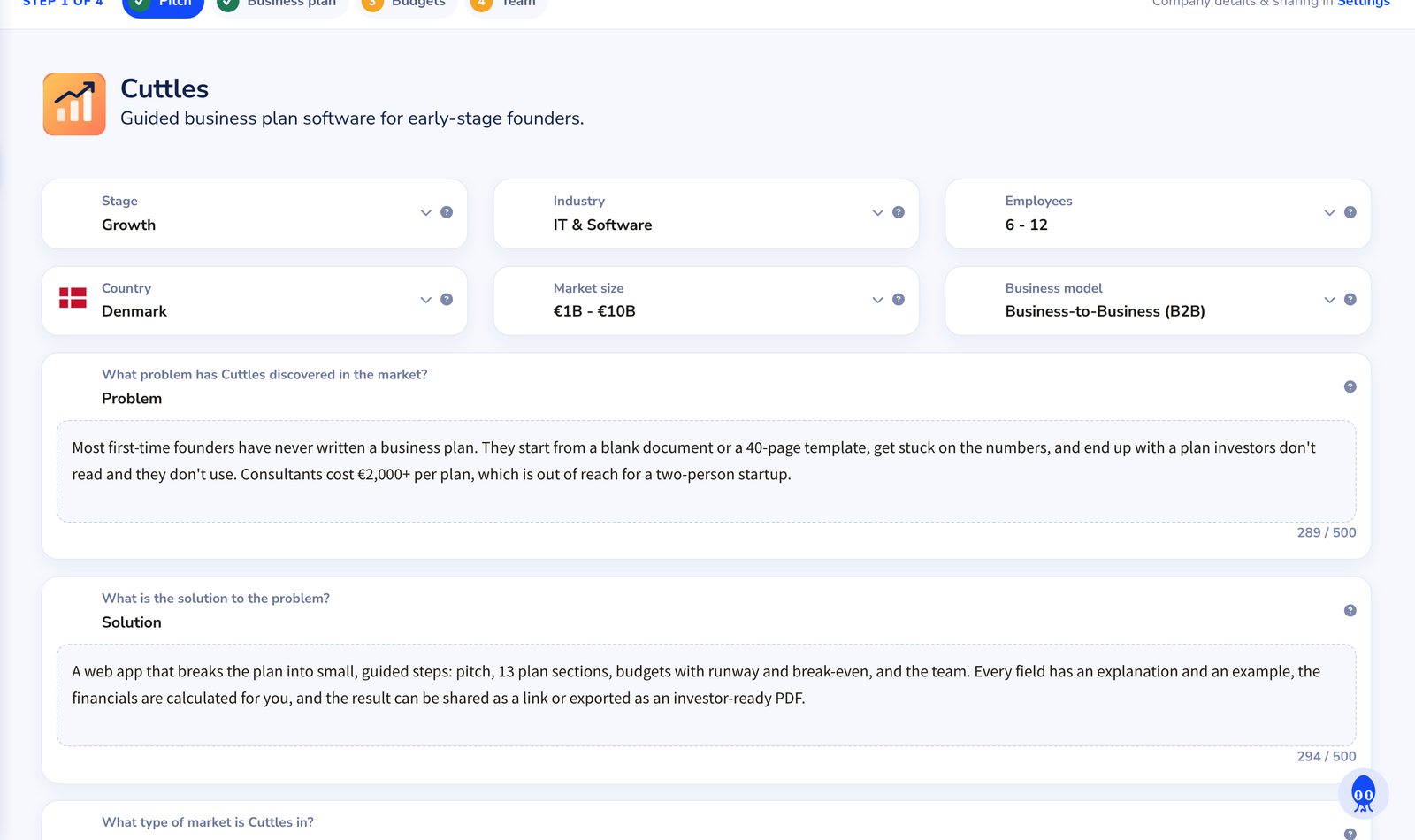
The pitch builder in Cuttles is a guided version of the one-page plan. You choose your stage, industry, number of employees, country, market size and business model from dropdowns, then fill in guided fields for Problem, Solution, Market, Unique Value Proposition, Business Model, Customer Segments, Channels, Competitors, Team, Traction and your funding status. Each field has a short explanation of what belongs in it.
The result is a one-page pitch view you can share as a live link, which always shows the latest version, with an optional password, or export as a PDF. If you write a field and want it tighter, the Grow and Series plans add [AI] Rewrite this and [AI] Polish to each field, applied to the text you wrote.
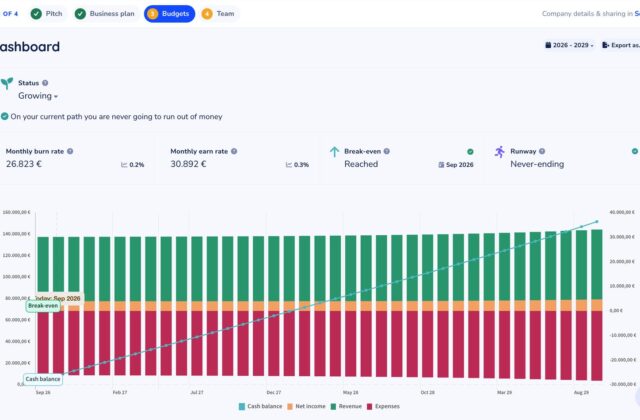
When a reader asks for more, you do not start over. The same startup gets a 13-section business plan editor and a budget that calculates burn rate, runway and break-even, and the budget charts appear in the plan’s Financials section automatically. For a head start, the app’s industry templates (see the public business plan examples) include a complete pitch you can copy and rewrite. Plans and prices are on the pricing page.

Sources
- U.S. Small Business Administration, Write your business plan (lean startup plans: typically one page, as little as an hour to write; the nine lean plan components).
- Kiln Street Studio is a fictional company. All figures in the example are illustrative and calculated from the stated assumptions.
If it doesn’t fit on one page, you haven’t decided yet. — Cuttles