How to Write a Positioning Statement (Template + 15 Examples)

A positioning statement is two sentences that nobody outside your company is supposed to read, and it still decides what goes on your homepage, in your pitch deck and in every ad you run. Founders tend to skip it because it looks like marketing homework. Then they spend months arguing about taglines that have nothing underneath them. This guide gives you the template, the six steps to fill it in honestly, 15 examples you can borrow the structure from, and a test that tells you whether your draft is any good.
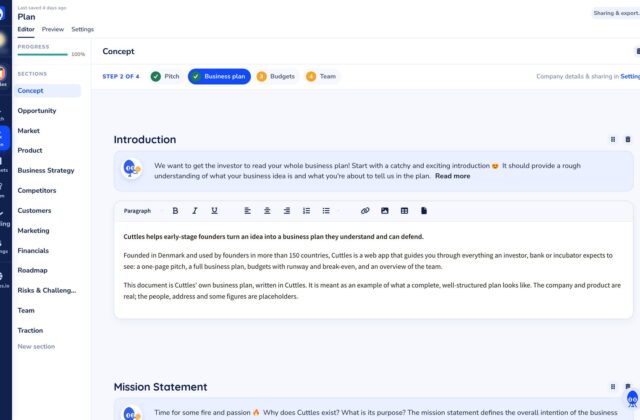
- A Brand Positioning section in the plan’s Marketing chapter, with a guide and an example answer
- A Unique Value Proposition field in the pitch builder that keeps the short version next to your problem and solution
- [AI] Rewrite this and [AI] Polish to tighten the sentences you wrote yourself
What a Positioning Statement Does
Your positioning statement says who you are for, what problem you solve for them, what kind of product you are, and why you are the better choice than the thing they use today. It is an internal document. You will rarely paste it word for word onto a website. Instead, it is the reference that your tagline, homepage headline, sales email and investor pitch all have to agree with.
Think of it as a decision filter. When a co-founder suggests a feature for enterprise buyers and your statement says you serve two-person accounting firms, the statement settles the argument before it starts. When a designer proposes a playful brand voice and your buyers are hospital procurement teams, same thing. A good statement makes a lot of small decisions for you.
For a startup, it also does a third job: it shows an investor that you know exactly which customer you are going after first. A plan that says “we help businesses be more productive” reads as unfocused. A plan that says “for dental clinics with two to five chairs who lose revenue to no-shows” reads as a company with a beachhead.
Most positioning statements follow the structure Geoffrey Moore set out in Crossing the Chasm, his book on how technology companies win their first mainstream market. The shape has barely changed since, because it works: it forces you to name a customer, a need, a category, a benefit and a competitor in the same breath.

The Positioning Statement Template
Here is the classic template, adapted from Moore. Every bracket is a decision, and most weak statements come from leaving one of them vague.
For [target customer] who [need or problem], [brand or product name] is the [product category] that [key benefit].
Unlike [main alternative], we [main point of difference, with proof].
| Part | What it answers | Weak version | Strong version |
|---|---|---|---|
| Target customer | Who buys first? | Small businesses | Independent physiotherapy clinics with one to four therapists |
| Need | What hurts today? | Want to save time | Lose about one appointment a day to late cancellations |
| Category | What kind of thing is this? | Platform | Online booking and reminder software |
| Key benefit | What changes for them? | Increases efficiency | Fills cancelled slots from a waitlist automatically |
| Alternative | What do they use now? | Competitors | A paper diary and phone calls, or general scheduling apps |
| Difference | Why you, and how do you prove it? | Better and easier | Built around insurance-billed treatment plans, set up in one afternoon |
The strong column is specific enough that a stranger could check each claim. That is the standard to aim for.
The short “only” version
Brand strategist Marty Neumeier proposed a one-line test in his book Zag: if you cannot finish the sentence “Our brand is the only ___ that ___” briefly and truthfully, you have not found a real difference yet. It works well as a companion to the full template. Write the long version for your plan, then squeeze it into the “only” line to check that the difference survives compression.
[Brand] is the only [category] that [difference] for [customer] in [place or situation].
The brand positioning statement
A brand positioning statement is the same idea aimed at how people should feel about the company as a whole, rather than one product. Consumer brands with several products tend to use it. It usually adds the reason to believe and a word or two about personality:
To [target customer], [brand] is the [frame of reference] that [main benefit], because [reason to believe]. We sound [two or three personality words].
If you sell one product to one customer group, which describes most startups in their first two years, the product and brand statements end up nearly identical. Write one, not both.
How to Write a Positioning Statement in 6 Steps
The template takes five minutes to fill in badly and a few days to fill in well. The time goes into the research behind each bracket, not the wording.
- Pick one customerThe group you can win first
- Name the needIn their words, with a cost
- Choose the categoryWhat they compare you to
- List the alternativesIncluding doing nothing
- Find the differenceOne claim you can prove
- Write, cut, testTwo sentences, then five readers
Step 1: Pick one customer group
Choose the group that feels the problem most sharply and that you can reach with the channels you have. You can widen later. A statement that names three customer groups is really three statements stitched together, and each one gets weaker. If you are unsure which group comes first, the guides on defining your target market and market segmentation walk through the choice. Describe the group with details you could filter a list by: industry, size, role, location, a behavior.
Step 2: Name the need in the customer’s words
Go back to your customer interviews and copy the phrases people used. “I spend Sunday evenings chasing invoices” is better raw material than “accounts receivable inefficiency”. Where you can, attach a cost: hours per week, money lost per month, a risk they worry about. If you have not done interviews yet, the guide on validating your idea covers how to run them. The problem statement in your plan and the need in your positioning statement should describe the same pain.
Step 3: Choose the category on purpose
The category tells the reader what to compare you with. Call yourself “accounting software” and buyers compare you with big accounting suites. Call yourself “an invoicing app for freelance designers” and they compare you with spreadsheets and email. Neither is wrong, but each sets up a different fight. Pick the category where your difference matters most and where buyers already have a budget line.
Be careful with invented categories. “The first relationship intelligence platform” forces the reader to work out what you are before they can care. A familiar category plus a sharp difference is usually easier to sell than a new category that needs explaining.
Step 4: List the real alternatives
Write down what your target customer does today when the problem shows up. For most early-stage startups the honest answer is a spreadsheet, a generalist tool, a freelancer, or nothing at all. Named competitors come after that. The alternative you put in the “unlike” clause should be the one your buyer most often uses, not the one you most enjoy beating. The SWOT analysis in your plan is a good place to collect them.
Step 5: Find one difference you can prove
Look for a difference that matters to the customer from step 1, that the alternative from step 4 does not offer, and that you can back up with a fact: a feature, a price, a speed, a certification, a team background, a result from a pilot. “Better customer service” fails this test because everyone claims it. “A named account manager who answers within one business hour, written into the contract” passes.
Step 6: Write it, cut it, test it
Fill in the template in one go, then cut every adjective that does not carry information. Read it aloud. Then show it to five people: two target customers, one person who knows your industry, and two who know nothing about it. Ask each of them to tell you, in their own words, who it is for and why they would choose it. If the answers drift, the statement is not clear yet.
First draft: “For small businesses who want to save time, Tallybird is an innovative financial platform that makes invoicing easy. Unlike other solutions, we are simple and affordable.”
What is wrong: “Small businesses” covers millions of companies, “save time” is every product’s promise, “financial platform” is not a category a buyer searches for, and “other solutions” names nobody.
Final: “For freelance designers in the U.S. who lose days each month chasing late client payments, Tallybird is the invoicing app that follows up on overdue invoices automatically and lets clients pay by card in two clicks. Unlike spreadsheets and email reminders, Tallybird sends polite, timed reminders from your own address, so the client relationship stays yours.”
“Only” test: “Tallybird is the only invoicing app that chases late payments from your own email address for freelance designers.”
Once the statement holds up, the short form usually becomes your unique value proposition. In Cuttles that is the UVP field in the pitch builder, and the full statement goes into the Brand Positioning section of your plan. If you wrote the draft yourself and it feels clunky, [AI] Rewrite this or [AI] Polish can tighten the sentences without changing what you decided.

15 Positioning Statement Examples
All 15 companies below are fictional. Real companies rarely publish their internal positioning statements, and the versions that circulate online are mostly reconstructions, so we have not put words in anyone’s mouth. Each example covers a different kind of startup so you can find one close to yours and borrow the structure.
B2B software
For dental clinics with two to five chairs who lose revenue to same-day cancellations, Chairside is the scheduling app that offers freed-up slots to a waitlist of patients by text within minutes. Unlike the booking module in their practice software, Chairside fills gaps without anyone at the front desk picking up the phone.
For independent restaurant owners who rebuild the staff rota every week in a group chat, Rotalane is the rota app that lets staff swap shifts themselves within rules the owner sets. Unlike general team chat, every swap is approved against overtime limits and shows up in payroll.
For self-employed electricians and plumbers who do their books once a year in a panic, Ledgerline is the bookkeeping app that turns photos of receipts into categorized expenses on the job site. Unlike desktop accounting software, it was designed for a phone held in one hand.
For food truck operators who juggle permits and inspections across several counties, Fieldnote is the compliance tracker that warns them 30 days before any permit expires. Unlike a folder of paper certificates, it shows an inspector every valid document from one screen.
Consumer apps and subscriptions
For parents in the first three months after a baby arrives, Hearthbox is the meal delivery service that sends freezer-ready dinners that reheat in one pan in under 15 minutes. Unlike standard meal kits, there is no chopping and no recipe card to follow.
For first-time marathon runners training around a full-time job, Stridewell is the coaching app that rewrites the week’s plan when they miss a session. Unlike fixed 16-week PDFs, the plan bends around real life instead of breaking.
For dog owners who switch vets or travel with their dog, Petlog is the health record app that keeps vaccinations, prescriptions and vet notes in one shareable file. Unlike paper booklets, a new vet can see the full history before the appointment starts.
Marketplaces
For small food producers who need a licensed kitchen a few days a month, Benchmate is the booking marketplace for commercial kitchens with spare hours. Unlike long-term kitchen leases, producers book by the half-day and every kitchen is verified as licensed.
For parents of high school students preparing for state exams, Tutorbridge is the tutoring marketplace that only lists tutors who currently teach the subject in a school. Unlike general tutoring sites, every tutor’s teaching license is checked before their profile goes live.
Physical products and retail
For home cooks who want to stop using nonstick coatings, Kiln & Co is the ceramic cookware brand that makes pans you can use on high heat every day. Unlike cast iron, the pans weigh about half as much and need no seasoning.
For phone owners who replace a case every time a corner cracks, Loopcase is the modular case with replaceable corner pieces. Unlike one-piece cases, a $4 spare corner fixes the damage in 30 seconds.
Services and local businesses
For daily bike commuters in Portland who cannot be without their bike for a week, Brightside Bikes is the mobile repair service that fixes the bike at their home or office on the same day. Unlike traditional bike shops, there is no drop-off and no waiting list in spring.
For landlords with fewer than ten rental units who need to cut heating bills, Nest Audit is the energy survey service that delivers a costed upgrade list within a week of the visit. Unlike general contractors, we do not sell the upgrades, so the list is not a sales pitch.
Health and education
For home care agencies with 20 to 100 caregivers, Carewave is the scheduling software that plans visit routes around each client’s care plan and each caregiver’s travel time. Unlike spreadsheets and whiteboards, schedule changes reach caregivers’ phones instantly with the updated route.
For hearing parents of deaf children under five, Signpath is the online sign language course built around everyday family routines like bath time and meals. Unlike general sign language apps, every lesson is taught by a deaf instructor who is also a parent.
Notice what the 15 have in common. Each names a customer narrow enough to picture, a need with a concrete consequence, a category a buyer would recognize, and a difference that is a fact rather than an adjective. None of them uses “innovative”, “leading” or “best-in-class”. Also notice that some of the differences would not suit a bigger company: “we do not sell the upgrades” only works because Nest Audit chose not to. Good positioning often comes from something you decided to give up.
Positioning Statement vs. UVP vs. Tagline vs. Mission Statement
These four get mixed up constantly, and a business plan often needs all of them. The difference is mainly audience and length.
| Positioning statement | Unique value proposition | Tagline | Mission statement | |
|---|---|---|---|---|
| Audience | Your team, investors, agencies | Prospective customers | Everyone, in passing | Team, partners, public |
| Length | Two to three sentences | One sentence plus a short line | Three to eight words | One or two sentences |
| Answers | For whom, what, why us over the alternative | What do I get and why should I pick you | What should I remember | Why does this company exist |
| Names competitors? | Yes, the main alternative | Usually implied, not named | No | No |
| Changes when | You change target customer or strategy | You change offer or pricing | You rebrand or run a campaign | Rarely |
| Where it lives in Cuttles | Marketing: Brand Positioning | Pitch and Opportunity: UVP field | Your own brand files | Concept: Mission Statement |
Write the positioning statement first. The other three are easier once it exists, because they are shorter views of the same decision.
For Tallybird from the example above, the set might look like this. Positioning: the two sentences in the example box. UVP: “Get paid on time without chasing clients yourself.” Tagline: “Invoices that follow up.” Mission: “Make sure independent designers get paid for the work they do.” Our guides to the mission statement and vision statement cover those two in detail.
Where the Positioning Statement Goes in Your Business Plan
In most business plans, positioning sits in the marketing section, after you have described customers and competitors. That order is deliberate: you cannot position against alternatives you have not described yet. Here is how the statement connects to the rest of the plan:
- Customers and personas: the target customer in your statement should match your primary persona. If your persona is “Maya, a first-time founder” and your statement says “growing mid-size companies”, one of them is wrong.
- Competitors: the alternative in your “unlike” clause should appear in your competitor section, with its strengths written down honestly.
- Price: your price has to fit the position. A premium difference with a budget price confuses buyers, and so does the reverse.
- Marketing channels: the channels you choose should be where your target customer from the statement actually spends time. The go-to-market strategy guide shows how to connect the two.
- Pitch deck: the one-line version usually becomes the subtitle on your first or second slide. See the pitch deck guide.
Cuttles lays the plan out in this order: Customers and Competitors come before Marketing, and Brand Positioning is a section inside Marketing, with a guide text and a worked example next to the field. Because the pitch builder has its own Unique Value Proposition field, the short version travels with your one-page pitch while the full statement stays in the plan.
Test Your Positioning Statement: Checklist
Run your draft through this list. Each “no” is a gap a customer, an investor or your own team will find later.
- The target customer is narrow enough that you could make a list of 50 of them.
- The need is written in words a customer actually used in an interview.
- The need has a cost attached: time, money, risk or stress you can describe.
- The category is one a buyer would type into a search box.
- The benefit describes a change for the customer, not a feature of the product.
- The “unlike” clause names the alternative customers use most today, even if that is a spreadsheet or nothing.
- The difference is a fact you can prove with a feature, a number, a policy or a credential.
- A competitor could not copy the statement word for word and have it be true for them.
- It passes the “only” test in one sentence.
- Five readers described who it is for and why they would choose it in roughly the same words.
- It matches your persona, competitor section, price and channels in the business plan.
Five Mistakes That Make Positioning Useless
- Positioning for everyone. The fear is that a narrow customer means a small business. In practice a narrow start is how you get word of mouth, because customers in a tight group talk to each other.
- Adjectives instead of differences. “Easy, fast and affordable” is what every competitor says too. Replace each adjective with the fact behind it: setup in one afternoon, results in 48 hours, $29 a month.
- Beating a competitor nobody uses. If your buyers mostly use spreadsheets, positioning against a well-known software brand wins an argument your customers are not having.
- Writing it once and filing it away. Revisit the statement whenever you change target customer, price or main competitor. A stale statement is worse than none, because people still follow it.
- Confusing it with the tagline. Trying to make the positioning statement catchy strips out the specifics that make it useful. Let the tagline be catchy; let the positioning be precise.
If you are still working out whether the idea has a market at all, the free startup idea validator helps you pressure-test it before you spend time on wording.
Sources
- Geoffrey A. Moore, Positioning and Crossing the Chasm (the origin of the “For / who / is a / that / unlike” positioning template).
- Marty Neumeier, The Onlyness Test, from the book Zag.
- All 15 example companies and Tallybird are fictional. Any resemblance to real companies is unintended.
Pick one customer, prove one difference, and the rest of your marketing has something to agree with. — Cuttles