Revenue Models: 12 Types With Startup Examples (and How to Pick One)

Two startups can sell the same thing to the same customers and end up with very different companies, because one charges per use and the other charges per month. The way you charge decides your cash flow, your growth rate, the metrics investors ask about and the lines in your budget. This guide covers 12 revenue models with well-known examples, then compares two of them for one fictional startup, with the numbers worked out.
- Add each revenue stream to your budget as a recurring or one-time item with its own growth rate
- See how each choice changes burn rate, runway and your break-even month
- Describe the model in the Business Model section of your plan, with a guide and example
What a Revenue Model Is (and What It Isn’t)
Your revenue model is the rule that turns customer activity into money: who pays, for what, how much and how often. “We charge restaurants $149 a month per location” is a revenue model. “We take 12% of each booking” is another. Everything else in your financial plan follows from that sentence, which is why it needs to be written down precisely.
Three terms get mixed up, so here is how they relate:
| Term | What it describes | Example |
|---|---|---|
| Business model | How the whole company creates, delivers and captures value: customers, channels, partners, costs and revenue | A marketplace that connects parents with local tutors |
| Revenue model | The capture part: the pricing mechanism | A 15% commission on each tutoring session booked |
| Revenue streams | The separate sources of income that the model produces, each its own line in the budget | Session commissions, a premium listing fee for tutors, sponsored placements |
Most startups begin with one revenue stream and add others later. That is usually the right order. A plan with five revenue streams in year one tells a reader you have not decided which one works. If you are filling in a Business Model Canvas, the revenue model is what goes in the “Revenue Streams” box; our Business Model Canvas examples show it in context.

12 Types of Revenue Models, With Examples
For each model below: how it works, a well-known company that uses it, and what the model means for your budget. The company examples show the mechanism, not a strategy to copy. Many large companies combine several models.
1. Subscription
Customers pay a fixed amount every month or year for continued access. Netflix is the standard example: its annual report states that it primarily earns revenue from monthly membership fees. Subscriptions make revenue predictable, which is why investors like them, but you earn the money slowly and have to keep earning it every month.
In your budget: a recurring revenue item, customers times price. Model new customers and churn (the share who cancel each month) separately, because a few percent of customers leaving each month can cancel out much of your new sales. Our guide to unit economics covers the metrics that go with it.
2. Freemium
A free tier attracts a large number of users, and a smaller share pays for more features. Spotify runs two reported segments: Premium, which earns mainly subscription fees, and Ad-Supported, which earns mainly from advertising sold against the free tier. Freemium works when the free tier costs you very little to serve and the paid tier is clearly better.
In your budget: free users do not appear as revenue, but they do appear as cost (hosting, support). Forecast paying users as a conversion rate of total users, and state that rate as an assumption you will test.
3. Usage-based (pay as you go)
Customers pay for what they consume: compute hours, messages sent, gigabytes stored, API calls. Amazon Web Services describes its pricing as pay-as-you-go. Usage pricing lowers the barrier to start, since small customers pay little, and revenue grows automatically as customers grow. The trade-off is that revenue moves up and down with your customers’ activity.
In your budget: customers times average usage times unit price. Show the usage assumption separately, because it is the number most likely to be wrong.
4. Transaction fee
You take a fee on each payment or transaction that passes through your product. Stripe charges businesses a percentage of each successful card payment plus a fixed amount per transaction, as listed on its pricing page. Revenue scales with the volume your customers process, not with the number of customers.
In your budget: transaction volume times your fee. Keep the volume (what passes through) and your revenue (the fee) in separate lines so nobody mistakes one for the other.
5. Marketplace commission
A marketplace connects buyers and sellers and keeps a share of each sale. Airbnb charges a service fee on bookings; under the single-fee structure it is deducted from the host’s payout, and its help center lists the fee as 15.5% for most hosts. The hard part is not the fee but building both sides of the market at the same time.
In your budget: gross booking value times take rate. The worked example below shows what happens to a marketplace budget when some bookings move off the platform.
6. Advertising
Users get the product for free, and advertisers pay to reach them. Alphabet reports that it generates revenue primarily by delivering online advertising. Advertising needs a very large or very specific audience before it pays well, so for most startups it is a second revenue stream, not the first.
In your budget: impressions or clicks times the rate advertisers pay. Before you have an audience, these numbers are guesses, so label them clearly.
7. Affiliate
You recommend another company’s product and earn a commission when your audience buys. Amazon Associates is one of the best-known programs: publishers earn commissions on qualifying purchases made through their links, paid about 60 days after the end of the month in which they were earned. Affiliate revenue suits content businesses, comparison sites and newsletters.
In your budget: visitors times click-through rate times conversion rate times commission. Remember the payment delay: revenue you earn in March arrives in late May or June, which matters for cash flow.
8. One-time product sales
Customers pay once and own the product. Apple reports its revenue in two categories, products and services, and its products line (iPhone, Mac, iPad and others) is the classic example of selling a physical product outright. One-time sales bring in cash upfront, but next month starts at zero again unless customers come back.
In your budget: units times price, with cost of goods as a separate expense. Repeat purchases, if you expect them, get their own line with their own assumption.
9. Markup and resale
You buy products from a supplier and sell them for more. Retailers, wholesalers and most ecommerce stores work this way. Costco is an instructive variant: its annual report separates net sales from membership fees, because the company keeps markups low and earns a second, recurring revenue stream from the membership card.
In your budget: sales at your price, with the purchase cost as cost of goods. Your gross margin (price minus purchase cost, divided by price) is the number to defend.
10. Licensing and royalties
You let other companies use your intellectual property (a design, technology, content, a brand) in exchange for fees. Arm earns licensing revenue when a company licenses its chip designs, and royalty revenue on chips that contain those designs when they ship. Licensing can have very high margins, but it depends on owning something others cannot easily build themselves.
In your budget: upfront license fees as one-time items, royalties as recurring items tied to your licensees’ sales volume.
11. Franchising
You let independent owners run a business under your brand and system. McDonald’s describes its conventional franchise arrangements as including initial fees plus continuing rent and royalties based on a percent of sales. A franchise model only works once the concept has been proven in your own locations.
In your budget: one-time franchise fees per new location, and recurring royalties as a percentage of each franchisee’s forecast sales.
12. Services: hourly, project or retainer
Clients pay for your time or for a defined piece of work. Accenture reports its revenue by type of work, consulting and managed services, which maps neatly to the difference between project work and ongoing contracts. Services bring in revenue from day one, but revenue is capped by the hours your team can bill.
In your budget: billable hours times rate, or number of retainer clients times monthly fee. Plan utilization honestly: nobody bills 40 hours a week.
Revenue Models Compared
Here are the 12 revenue model examples side by side. “Predictability” is how well you can forecast next month from this month.
| Model | Who pays | When you get paid | Predictability | Key budget driver |
|---|---|---|---|---|
| Subscription | User | Every month or year | High | New customers minus churn |
| Freemium | A share of users | Every month or year | Medium | Free-to-paid conversion rate |
| Usage-based | User | After use, usually monthly | Medium | Usage per customer |
| Transaction fee | Business processing payments | Per transaction | Medium | Payment volume |
| Marketplace commission | Buyer, seller or both | Per transaction | Medium | Booking value times take rate |
| Advertising | Advertiser | Monthly, often in arrears | Low early on | Audience size and engagement |
| Affiliate | Partner company | Weeks after the sale | Low | Traffic and conversion |
| One-time product sales | Buyer | At purchase | Low to medium | Units and repeat rate |
| Markup and resale | Buyer | At purchase | Medium | Gross margin |
| Licensing and royalties | Licensee | Upfront plus per unit shipped | Medium | Licensees’ sales volume |
| Franchising | Franchisee | Upfront plus ongoing royalties | High once established | Number of locations |
| Services | Client | Per project or monthly retainer | Medium | Billable hours or retainer count |
Types of revenue models compared by who pays, payment timing, predictability and the number your forecast depends on.
Two patterns stand out. Models where money arrives before or at the moment of value (subscriptions paid upfront, product sales, retainers) are kinder to your cash. Models where you get paid later or per event (advertising, affiliate, usage) are harder to forecast and need a bigger cash buffer. If your runway is short, that matters as much as which model could grow largest. The burn rate and runway calculator shows how much buffer you have today.
Worked Example: Commission vs Subscription for One Startup
TutorLoop is a marketplace where parents book local tutors. The average session costs $50. The founders are choosing between two revenue models for year one: Model A, a 15% commission on every session booked through the platform, or Model B, a flat $40 monthly subscription for tutors with no commission, where tutors take payment themselves.
Both models use the same growth assumptions, so the only difference is how TutorLoop charges. All numbers are illustrative:
- Active tutors: 40 in month one, growing by 15 a month, so 205 in month twelve. That is 1,470 tutor-months over the year (40 + 55 + … + 205).
- Sessions booked: 400 in month one, growing by 200 a month, so 2,600 in month twelve. That is 18,000 sessions over the year, about 10 to 13 per tutor per month.
- Card processing: an illustrative 3% of whatever TutorLoop collects. In Model A, TutorLoop collects the full $50 per session and pays the tutor out. In Model B, it collects only the subscriptions.
| Year 1 (illustrative) | Model A: 15% commission | Model B: $40/month subscription |
|---|---|---|
| Volume | 18,000 sessions | 1,470 tutor-months |
| Money processed | $900,000 | $58,800 |
| Revenue | $135,000 | $58,800 |
| Card processing at 3% of money processed | −$27,000 | −$1,764 |
| Revenue after processing | $108,000 | $57,036 |
| Month 12 revenue | $19,500 | $8,200 |
Model A: 18,000 × $50 × 15% = $135,000. Model B: 1,470 × $40 = $58,800. Processing: 3% of $900,000 = $27,000 and 3% of $58,800 = $1,764.
On paper, Model A earns almost twice as much. But the table hides the question that decides it. Under Model A, a tutor at the month-twelve average of 12.7 sessions pays TutorLoop about $95 a month in commission (12.7 × $7.50). Under Model B, the same tutor pays $40. Once a family and a tutor know each other, both have a reason to arrange the next session outside the platform. That is called leakage, and every commission marketplace has to plan for it.
So test it. Model A’s revenue after processing falls in direct proportion to the share of sessions that leave the platform:
| Share of sessions booked off-platform | Model A revenue after processing | Model B revenue after processing |
|---|---|---|
| 0% | $108,000 | $57,036 |
| 30% | $75,600 | $57,036 |
| 47% | $57,240 | $57,036 |
| 60% | $43,200 | $57,036 |
Model A at leakage L = $108,000 × (1 − L). The two models are roughly equal at about 47% leakage ($57,036 ÷ $108,000 = 0.528).
Now the decision is concrete. If the founders believe they can keep more than half of repeat sessions on the platform, through scheduling, reminders, payment protection and reviews that only count for booked sessions, the commission wins. If tutors mostly want a listing to find their first few families, the subscription is safer and easier to sell. A third option is a hybrid: a lower commission plus a small monthly fee. Whichever they pick, the plan should state the leakage assumption in writing, because it is the number an investor will ask about.
This is the kind of comparison a budget makes easy. In Cuttles you would build two budgets for the same startup, one per model, and compare revenue, burn rate and break-even month on each dashboard. For the demand side of the forecast, see our guide to sales forecasting.

How to Choose a Revenue Model
Work through these steps in order. Each one narrows the options before the next.
- How customers buy todayWhat they already pay for, and how often
- When value happensOnce, continuously, or per use
- Who has the budgetUser, employer, advertiser or partner
- Your costsFixed, per customer or per transaction
- Your cashHow long you can wait to get paid
- TestModel two options in a budget, then ask customers
Match how customers already pay
If your customers already pay monthly for similar tools, a subscription is easy to understand. If they buy a similar product once every few years, a subscription needs a strong reason, such as ongoing service or updates, or they will resist it. Look at what your competitors charge and how; our guide to market analysis covers where to find that.
Charge when the customer gets value
A product used every day fits a subscription. A product used in bursts (tax season, a move, a wedding) fits one-time or usage pricing. When the charge and the value arrive at the same moment, customers complain less and cancel less.
Check your cost structure
If each extra customer costs you almost nothing, freemium and low-priced subscriptions can work. If each customer or transaction has a real cost (a tutor’s time, shipping, a server bill), make sure the model covers it at every volume. The break-even point formula tells you how many sales each option needs to cover fixed costs, and our guide to pricing strategy covers the price itself.
Be honest about cash
Advertising and affiliate revenue arrive late and grow slowly. If you have six months of runway, a model that pays upfront (annual subscriptions, deposits, retainers) buys you time. You can always add a slower revenue stream later.
Revenue Model Checklist
Before you write the revenue model into your plan, check that you can answer yes to each line.
- You can state the model in one sentence: who pays, for what, how much and how often.
- Customers already pay for something similar in a similar way.
- The price covers the cost of serving one more customer or transaction.
- Your budget has one line per revenue stream, with the driver (customers, usage, volume) shown separately from the price.
- Churn, conversion or leakage is written down as an assumption, not left out.
- You know when the cash arrives, not just when the sale happens.
- You have modeled at least one alternative and can say why you rejected it.
- Year-one revenue depends on one or two streams, not five.
- At least a few potential customers have seen the price and the payment terms.
[Company] earns revenue from [who pays] through [model]. We charge [price and unit], billed [when]. In year one we expect [volume driver], which gives [revenue]. We chose this model over [alternative] because [reason]. The key assumption is [churn, conversion or leakage rate], which we will test by [method and date].
Where the Revenue Model Goes in Your Business Plan
The revenue model appears in three places, and they must say the same thing. Your pitch states it in a line. In the plan, the Business Model section explains it: who pays, the price logic, and why this model fits your customers. The Financials section then shows it as numbers.
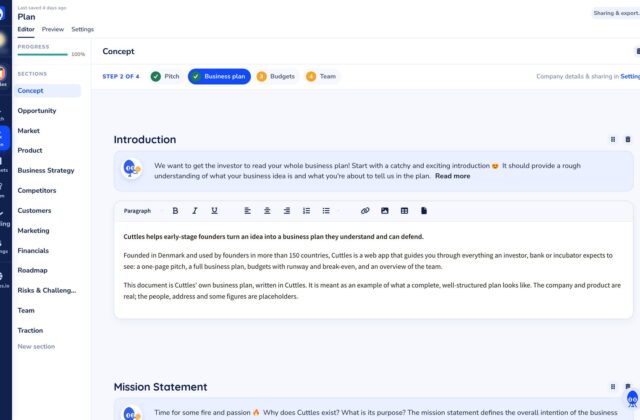
In Cuttles, those three places are connected. The pitch builder has a Business Model dropdown and field, the plan editor has a Business Model section under Business Strategy with its own guide and example, and the Revenue tab of your budget holds the streams as items: recurring or one-time, with start and end dates, amount, period and growth rate. The Financials section of the plan pulls the revenue chart straight from the budget. After you write the Business Model section in your own words, [AI] Rewrite this or [AI] Polish can tighten it, and “Revert to my text” brings back your original. The guide to writing a startup business plan shows where the section fits in the full plan, and the industry business plan examples show revenue models written out for a coffee shop, a restaurant and a food truck.
Sources
- Netflix, Inc., Form 10-K for fiscal year 2025 (revenue primarily from monthly membership fees).
- Spotify Technology S.A., Form 20-F for fiscal year 2025 (Premium and Ad-Supported segments).
- Amazon Web Services, AWS Pricing (pay-as-you-go pricing).
- Stripe, Pricing (percentage plus fixed fee per successful card transaction).
- Airbnb, Airbnb service fees (single-fee structure, 15.5% for most hosts).
- Alphabet Inc., Investor relations and annual reports (revenue primarily from online advertising).
- Amazon, Amazon Associates program (commissions on qualifying purchases, paid about 60 days after month end).
- Apple Inc., Investor relations and annual reports (products and services revenue categories).
- Costco Wholesale, Investor relations and annual reports (net sales and membership fees reported separately).
- Arm Holdings, Q4 and full-year FYE25 results (licensing and royalty revenue).
- McDonald’s Corporation, Form 10-K for fiscal year 2023 (franchise arrangements: initial fees, rent and royalties).
- Accenture, Form 10-K for fiscal year 2025 (revenue by type of work: consulting and managed services).
- TutorLoop is a fictional company. All figures in the example are illustrative and calculated from the stated assumptions.
Pick the model your customers already understand, then let the budget tell you whether it pays. — Cuttles