Startup Budget Template: Plan Your First 12 Months

A startup budget template is only useful if it answers one question: in which month does the money run out, and what has to be true for it not to? This guide gives you the categories to fill in, a complete 12-month budget for a fictional software startup where every total adds up, and the monthly routine that keeps the budget honest once real numbers start arriving.
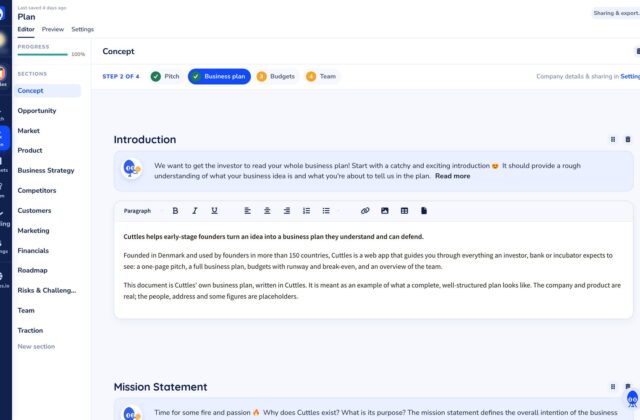
- Recurring and one-time expenses with start date, end date, growth and growth rate
- A dashboard with monthly burn rate, earn rate, break-even month and runway
- Budget charts flow straight into the Financials section of your business plan
What a Startup Budget Covers
A startup budget is a month-by-month plan of the money coming into your business and the money going out, from the day you start spending until at least the end of your first year. It has three parts:
- Capital: money you put in or raise (owner contribution, friends and family, angel investment, grants). This is not revenue.
- Expenses: everything you pay for, split into one-time costs (setup, equipment, legal formation) and recurring costs (salaries, software, rent, marketing).
- Revenue: what customers pay you, built from a customer count and a price rather than a guess at a total.
The output that matters most is the cash balance at the end of each month. From it you can read your burn rate (how much cash you lose per month), your runway (how many months until cash hits zero) and your break-even month (the first month revenue covers costs).
The U.S. Small Business Administration makes the same split in its guide to startup costs. It lists equipment, logo design, permits, licenses and fees as typical one-time expenses and salaries, rent and utilities as monthly ones, and it recommends tracking at least one year of monthly expenses, with five years as the ideal. For an early-stage startup, 12 months in detail plus a rougher years two and three is a practical middle.
A budget is different from a financial projection in emphasis. The projection is what you show investors: revenue growth over three to five years. The budget is what you run the company with: specific costs, specific months, and a cash line you check every month. In practice they are the same model, looked at from two ends.

The Startup Budget Template, Category by Category
Use this table as your checklist of lines. Not every startup needs every line: a software company may have no rent, a café has no contract developers. Delete what does not apply, but go through each row before you do. Missing lines, not wrong numbers, are the most common reason a startup budget comes up short.
| Category | Typical lines | Type | How to estimate |
|---|---|---|---|
| Company setup | Formation and state filing fees, registered agent, legal review of founder agreements | One-time | Check your state’s filing fee; ask a lawyer for a fixed quote |
| Equipment | Laptops, phones, tools, machinery, furniture | One-time | Price the actual items you will buy |
| Brand and website | Logo, website build, domain, launch photography | One-time (domain recurring) | Two or three quotes, or your own time if you do it yourself |
| Licenses and permits | Business license, industry permits, health or safety inspections | One-time, some annual | Your city and state licensing offices |
| Premises | Rent, deposit, build-out, utilities | Deposit and build-out one-time; rent recurring | Listings in your target area; deposit is often one to three months’ rent |
| People | Founder salaries, employees, contractors, employer payroll taxes, benefits | Recurring | Salary plus employer taxes; add benefits if you offer them |
| Software and hosting | Cloud hosting, email, accounting software, design tools, CRM | Recurring | List every subscription and its plan price |
| Marketing | Paid ads, content, events, launch campaign | Launch one-time; ongoing recurring | Work back from customers needed and cost per customer |
| Professional services | Accountant, bookkeeper, lawyer on retainer | Recurring | Monthly or annual quotes |
| Insurance | General liability, professional liability, cyber, equipment | Recurring (often annual) | Quotes from two brokers |
| Cost of sales | Materials, inventory, payment processing fees, shipping | Recurring, varies with sales | A percentage or amount per sale |
| Contingency | Buffer for what you forgot | Recurring or one lump | A set monthly amount or a share of total costs |
A business budget template works the same way for an established small business: the setup rows shrink and the recurring rows carry the weight.
Two rows deserve extra attention. Employer payroll taxes are easy to forget: in the U.S. the employer pays 6.2% Social Security and 1.45% Medicare on wages, 7.65% in total, on top of the salary itself (the IRS sets these rates, and wage caps apply to Social Security). Payment fees scale with revenue, so enter them as a percentage, not a fixed amount. If you want a quick first total for the one-time rows, the free startup cost calculator adds them up, and our guide to startup costs lists common expenses by business type.
How to Create a Startup Budget in 6 Steps
- List one-time costsEverything before launch
- List recurring costsWith the month each one starts
- Build revenue from driversCustomers times price
- Add capitalOnly money you have or have committed
- Calculate monthly cashStarting cash plus in, minus out
- Read the resultLowest month, runway, break-even
Step 1: List one-time costs, with the month you pay them
A one-time cost still has a date. A launch campaign in month three hits cash in month three, not spread across the year. Put each one in the month you expect to pay the invoice.
Step 2: List recurring costs, with start and end months
Recurring costs rarely start on day one together. A contractor may start in month one and stop in month six. Marketing may be small before launch and larger after. Give each line a start month, an end month if it has one, and a growth rate if it rises over time (a salary increase, a hosting bill that grows with users).
Step 3: Build revenue from drivers, not totals
Never type “$10,000” into a revenue cell. Type the number of customers and the price, and let the multiplication happen. That way, when a reader asks “why $10,000?”, the answer is already in the budget: 127 customers at $79 is $10,033, not a round number anyone picked. It also makes it easy to test a slower month. Our guide to sales forecasting covers how to set the customer numbers.
Step 4: Add capital you actually have
Put in the money you have in the bank or that is formally committed, in the month it arrives. If you are planning to raise, build the budget without the raise first. That shows you the month you need the money by, which is the most useful number you can bring to a funding conversation.
Step 5: Calculate cash month by month
Step 6: Read the result
Find three things: the month where cash is lowest, the first month net cash flow turns positive (break-even), and how many months of runway you have at any point. The next section shows all three in a full example.
A Worked 12-Month Startup Budget
ShiftNote is a fictional software startup that builds staff schedules for small medical clinics. Two founders pay themselves a modest salary, a contract developer finishes the product, and the service launches in month three at $79 per clinic per month. All numbers are illustrative, but every figure below is calculated from the assumptions, so you can check the arithmetic.
Capital: $90,000 in month 1 ($30,000 from the founders, $60,000 from an angel investor).
One-time costs: $7,000 in month 1 (company formation and legal $1,500, laptops $3,000, logo and website $2,500) and a $3,000 launch campaign in month 3.
Fixed recurring costs: $8,306 a month (see table below).
Marketing: $500 a month in months 1 and 2, then $1,500 a month from launch.
Revenue: $79 per clinic per month, starting with 12 clinics in month 3 and growing to 165 clinics by month 12. Card payment fees are 3% of revenue.
| Recurring cost | Per month | Year 1 |
|---|---|---|
| Founder salaries (2 × $2,000) | $4,000 | $48,000 |
| Employer payroll taxes (7.65% of salaries) | $306 | $3,672 |
| Contract developer | $3,000 | $36,000 |
| Software and hosting | $400 | $4,800 |
| Insurance | $150 | $1,800 |
| Accountant | $200 | $2,400 |
| Contingency | $250 | $3,000 |
| Fixed recurring subtotal | $8,306 | $99,672 |
| Marketing ($500 × 2 + $1,500 × 10) | varies | $16,000 |
| Payment fees (3% of revenue) | varies | $1,955 |
| Total recurring costs | $117,627 |
ShiftNote is fictional. Payment fees are rounded to the nearest dollar each month.
Now the 12 months. Recurring costs in each month are the $8,306 fixed subtotal plus that month’s marketing and payment fees. Month 1 also includes the $90,000 of capital in the cash column.
| Month | Clinics | Revenue | Recurring costs | One-time costs | Net cash flow | Cash at month end |
|---|---|---|---|---|---|---|
| 1 | 0 | $0 | $8,806 | $7,000 | −$15,806 | $74,194 |
| 2 | 0 | $0 | $8,806 | $0 | −$8,806 | $65,388 |
| 3 | 12 | $948 | $9,834 | $3,000 | −$11,886 | $53,502 |
| 4 | 24 | $1,896 | $9,863 | $0 | −$7,967 | $45,535 |
| 5 | 38 | $3,002 | $9,896 | $0 | −$6,894 | $38,641 |
| 6 | 54 | $4,266 | $9,934 | $0 | −$5,668 | $32,973 |
| 7 | 70 | $5,530 | $9,972 | $0 | −$4,442 | $28,531 |
| 8 | 88 | $6,952 | $10,015 | $0 | −$3,063 | $25,468 |
| 9 | 106 | $8,374 | $10,057 | $0 | −$1,683 | $23,785 |
| 10 | 124 | $9,796 | $10,100 | $0 | −$304 | $23,481 |
| 11 | 144 | $11,376 | $10,147 | $0 | $1,229 | $24,710 |
| 12 | 165 | $13,035 | $10,197 | $0 | $2,838 | $27,548 |
| Year 1 | $65,175 | $117,627 | $10,000 | −$62,452 | $27,548 |
Check: $90,000 capital − $62,452 net cash flow = $27,548 cash at the end of month 12. Revenue = clinics × $79.
What the budget tells ShiftNote’s founders
- Break-even month: month 11, at 144 clinics. Fixed costs plus marketing come to $9,806 a month, and each clinic brings in $79 minus 3% fees, about $76.63. So break-even needs about 128 clinics ($9,806 ÷ $76.63 = 128.0). Month 10 has 124, month 11 has 144.
- Lowest cash: $23,481 at the end of month 10. That is the number to watch. Everything before it is spending the raise; everything after it is the business paying for itself.
- Total cash burned in year one: $62,452 of the $90,000 raised.
- Runway at launch: at the end of month 4, cash is $45,535 and that month’s burn is $7,967. At a constant burn, that is 5.7 months of runway ($45,535 ÷ $7,967). Because revenue is growing, the real runway is longer, which is exactly why a monthly budget beats a single runway figure.
The same budget with slower growth
Now the test that matters. Suppose ShiftNote signs 30% fewer clinics every month than planned (115 by month 12 instead of 165) with the same costs. Cash then ends month 12 at $8,621, the business is still burning $994 a month, and break-even slips into year two. The plan is not broken, but $8,621 is roughly one month of fixed costs. The founders would want to decide in advance what they cut first (the contract developer after launch is the obvious candidate) and the month they would make that call.
That kind of downside scenario is the most useful page you can add to a budget. For more on this, see our guides to the cash flow forecast and burn rate. You can also try your own numbers here:
Free calculator: burn rate and runway
Your burn and runway
Turn these numbers into a full business plan with budgets, runway and a pitch. 7-day free trial, plans from €8/month.

How to Set Your Budget Assumptions
A budget is a stack of assumptions. The goal is not to get each one right, which is impossible before launch. The goal is to make each one visible and defensible, so you and your readers can argue with it.
| Assumption | Weak basis | Better basis |
|---|---|---|
| Price | What feels right | What customers pay for the alternative today, plus price tests or pre-orders |
| Customers per month | A percentage of the whole market | Marketing budget ÷ expected cost per customer, capped by what your team can onboard |
| Salaries | A round number | Local salary data for the role, plus 7.65% employer payroll taxes in the U.S. |
| Rent | A national average | Three current listings in the exact area you want |
| Software | “About $200” | A list of every tool with its plan price |
| Launch date | The date you hope for | Your hoped-for date plus one or two months |
Write the basis next to each line, in a notes column or a short paragraph in your plan. In ShiftNote’s case, “12 clinics in month 3” should come with the reason: the founders have 20 letters of intent from clinics they interviewed, and they expect just over half to convert. That sentence does more for a reader’s trust than any chart.
Three habits keep assumptions honest:
- Be conservative on revenue timing. Customers usually arrive later than planned, and costs usually arrive on time.
- Tie marketing to customers. If you budget $1,500 a month and expect a clinic to cost $75 to acquire, that supports 20 new clinics a month. ShiftNote’s plan adds 12 to 21 a month after launch, which fits.
- Keep a contingency line. ShiftNote’s $250 a month is small; a business with physical premises or inventory should carry more.
Monthly Budget Review Checklist
A budget written once and never opened again is a document, not a tool. Set a fixed day each month, ideally within the first week, and work through this list with your bank statement and accounting software open.
- Enter last month’s actual revenue, costs and cash next to the budget.
- Mark every line that is more than 10% off the budget, and write one sentence on why.
- Check new customers against plan. If they are behind, move the forecast, don’t just hope for a catch-up.
- Look for new recurring costs (a new subscription, a contractor) that are not in the budget yet.
- Cancel any subscription nobody used last month.
- Recalculate the lowest cash month and runway with the updated numbers.
- Compare runway with how long a funding round or grant takes to close, and start early if the gap is small.
- Update the downside scenario, not just the main plan.
- Share a short summary (cash, burn, runway, customers) with co-founders and any investors.
Spreadsheet or Budget Tool?
A spreadsheet is a perfectly good way to build a startup budget, and many founders should use one. The question is how much time you want to spend on formulas versus decisions, and whether the budget needs to live inside a business plan.
| Spreadsheet template | Cuttles budget | |
|---|---|---|
| Cost | Free | From €8/mo on a yearly plan, 7-day free trial |
| Flexibility | Unlimited: any formula, any layout | Structured: expenses, revenue and capital as items with dates and growth |
| Setup time | Hours if you build the formulas yourself | Enter items; totals and charts are calculated |
| Burn, runway, break-even | You build the formulas | Calculated on the dashboard |
| Multi-year view | As many columns as you add | Year-by-year report of capital, expenses, revenue and cash balance |
| Scenarios | Copy the sheet or add scenario switches | Several budgets per startup |
| Link to business plan | Copy and paste charts | Charts appear in the plan’s Financials section automatically |
| Formula errors | Possible, and hard to spot | None to write |
Choose a spreadsheet if you are comfortable modeling, need an unusual structure (inventory with lead times, complex unit economics) or your accountant wants one. Choose a budget tool if you want the numbers built quickly and kept in step with a business plan that investors or grant reviewers will read. Some founders do both: a detailed spreadsheet for internal decisions and a clean budget in the plan.

Once your budget is in place, the next steps are the break-even point formula and the Financials section of your business plan. If you plan to apply for funding, the startup grants database shows grants by country, with amounts, deadlines and who can apply, and funding match, which matches grants and investors to your plan, is coming to every yearly Cuttles plan.
A Note for UK Founders
The template works the same in pounds. The main line that changes is payroll: instead of U.S. Social Security and Medicare, a UK employer pays employer National Insurance contributions on salaries above a threshold, plus workplace pension contributions for eligible staff. Rates and thresholds change, so take them from HMRC’s current published rates on gov.uk rather than from an old template, and budget them as a separate line from the salaries themselves.
Sources
- U.S. Small Business Administration, Calculate your startup costs (one-time vs. monthly expenses; track at least one year of monthly expenses).
- Internal Revenue Service, Topic no. 751, Social Security and Medicare withholding rates (6.2% and 1.45% employer share).
- GOV.UK, Rates and thresholds for employers (employer National Insurance).
- ShiftNote is a fictional company. All figures in the example are illustrative and calculated from the stated assumptions.
Find your lowest cash month before the bank statement does. — Cuttles