Startup Costs: 40 Common Expenses to Budget For (Checklist + Examples)

Founders rarely run out of money because of one big expense they forgot. They run out because of twenty small ones, plus the months where revenue is lower than planned. This guide gives you a 40-item list of startup costs, shows how to estimate each group, and walks through two fictional businesses from first receipt to a total you could put in a business plan.
- Enter each cost as a one-time or recurring item, with a start date, amount and growth rate
- See burn rate, runway and your break-even month calculated from those items
- The same charts appear in the Financials section of your business plan
What Counts as Startup Costs
Startup costs are the money you spend to get a business to the point where it can serve customers and pay its own bills. In a business plan, that total has two parts, and most first drafts only include the first one:
- One-time costs: what you pay once to open. Company registration, equipment, a website build, a security deposit, opening inventory, a launch campaign.
- Recurring costs until the business covers itself: rent, software, insurance, wages and your own pay for the months before revenue catches up. These are operating expenses, but you still have to fund them before you open the doors, so they belong in your startup budget.
The U.S. Small Business Administration makes the same split. Its guide to calculating startup costs lists buying major equipment, hiring a logo designer and paying for permits and licenses as typical one-time expenses, and salaries, rent and utilities as monthly ones. It also suggests projecting at least one year of monthly expenses.
Startup expenses in the tax sense are narrower than that. The IRS treats costs you incur before you begin operating (advertising, travel, surveys, training) as start-up costs with their own deduction rules, and treats equipment as an asset you depreciate. We cover the tax side further down. For planning, count everything that leaves your account before the business pays for itself.

The List of Startup Costs: 40 Common Expenses
Go through the list and mark each line as yes, no or not yet. Most businesses need 20 to 30 of these. The “Type” column tells you whether it is a one-time cost, a recurring cost, or both (a setup fee followed by a monthly charge). The last column tells you where to get a real number instead of a guess.
Legal and administration (1 to 8)
| # | Expense | Type | How to estimate |
|---|---|---|---|
| 1 | Business formation filing (LLC, corporation) | One-time | Your state’s fee schedule, published by the Secretary of State |
| 2 | Registered agent service | Recurring (yearly) | Quotes from two or three providers, or $0 if you act as your own agent |
| 3 | Business licenses and permits | One-time + renewals | City and county licensing offices; health, fire and signage permits for premises |
| 4 | Legal fees (operating agreement, contracts, terms) | One-time | A fixed-fee quote from a small-business attorney |
| 5 | Accountant setup and first tax advice | One-time | Fixed-fee quote; ask what the first-year return will cost too |
| 6 | Trademark filing | One-time | The USPTO fee schedule for each class you file in |
| 7 | Business bank account fees | Recurring | The bank’s fee sheet; many accounts waive fees above a balance |
| 8 | Business insurance (liability, professional, property) | Recurring | Two or three broker quotes; ask for monthly and annual prices |
Location and premises (9 to 15)
| # | Expense | Type | How to estimate |
|---|---|---|---|
| 9 | Security deposit on the lease | One-time | Written into the lease, often one to three months of rent |
| 10 | Rent | Recurring | The listing or lease draft; include common-area and maintenance charges |
| 11 | Build-out and renovation | One-time | A contractor quote based on your floor plan, never a per-square-foot guess |
| 12 | Furniture and fixtures | One-time | A shopping list with prices, item by item |
| 13 | Utility connection fees and deposits | One-time | Call the utilities for the address; new commercial accounts often need a deposit |
| 14 | Utilities (power, water, gas, waste) | Recurring | Ask the landlord or previous tenant for 12 months of bills |
| 15 | Exterior and interior signage | One-time | Sign-maker quote plus the permit (line 3) |
Equipment and technology (16 to 22)
| # | Expense | Type | How to estimate |
|---|---|---|---|
| 16 | Computers, phones and peripherals | One-time | Price list per person; count only what you do not already own |
| 17 | Specialized equipment or machinery | One-time | Supplier quotes, including delivery and installation |
| 18 | Software subscriptions | Recurring | List every tool with its per-seat price and the number of seats |
| 19 | Point-of-sale system | One-time + recurring | Hardware price plus the monthly plan |
| 20 | Website design and build | One-time | A fixed quote or your own hours times a realistic rate |
| 21 | Domain, hosting and email | Recurring | The provider’s published plans |
| 22 | Internet and phone service | Recurring | Business plans available at your address |
Product and inventory (23 to 26)
| # | Expense | Type | How to estimate |
|---|---|---|---|
| 23 | Opening inventory | One-time | Units you need on day one times supplier price, with minimum order quantities |
| 24 | Materials and packaging | Recurring | Cost per unit sold times your sales forecast |
| 25 | Product development and prototypes | One-time | Developer or manufacturer quotes; plan for at least one revision |
| 26 | Shipping, freight and fulfillment | Recurring | Carrier rate calculators for your typical parcel size |
Marketing and launch (27 to 32)
| # | Expense | Type | How to estimate |
|---|---|---|---|
| 27 | Brand identity and logo | One-time | Designer quote with a fixed number of revisions |
| 28 | Market research and validation | One-time | Survey tools, test ads and interview incentives; see our guide on how to validate your idea |
| 29 | Launch campaign | One-time | Target number of first customers times what you expect each to cost to acquire |
| 30 | Ongoing advertising | Recurring | A monthly budget tied to the customers your revenue forecast needs |
| 31 | Printed materials (cards, menus, flyers) | One-time | Printer quote for the first run |
| 32 | Opening event or promotion | One-time | Itemize: food, discounts given, staff hours |
People (33 to 38)
| # | Expense | Type | How to estimate |
|---|---|---|---|
| 33 | Founder pay | Recurring | The minimum each founder needs to cover personal costs; zero is a choice, not a default |
| 34 | Employee wages | Recurring | Hours per week times hourly rate, or salary divided by 12 |
| 35 | Payroll taxes and benefits | Recurring | Ask your accountant or payroll provider for the rate on top of gross pay in your state |
| 36 | Recruiting and hiring | One-time | Job board fees, background checks, your own hours |
| 37 | Training and certification | One-time | Course fees plus paid hours before the employee is productive |
| 38 | Contractors and freelancers | Recurring | Hourly or monthly retainer quotes |
Money and buffer (39 to 40)
| # | Expense | Type | How to estimate |
|---|---|---|---|
| 39 | Payment processing fees | Recurring | Your processor’s published rate times forecast card revenue |
| 40 | Contingency reserve | One-time | A percentage of everything above; see the contingency section |
The 40 common business startup costs, grouped by category. Lines marked “One-time + recurring” go into your budget twice: once as a setup cost and once as a monthly item.
Two costs are missing from most lists because they don’t feel like spending. The first is your own time: if you give up a salary to start, line 33 is where that shows up. The second is the gap between paying suppliers and getting paid by customers. If you pay for inventory 30 days before you sell it, or invoice clients on 30-day terms, you need cash to cover that gap, and a cash flow forecast will show you how much.
How to Estimate Startup Costs Without Guessing
A startup cost estimate is only as good as its weakest line. Readers of your plan will not check every number, but they will check the two or three biggest ones, so put your effort there.
- ListGo through the 40 lines and keep what applies
- SplitMark each as one-time, recurring or both
- QuoteGet written prices for the five largest items
- DateGive every item a month when it starts
- Forecast revenueMonth by month, from customers times price
- Find the gapAdd up the months where costs exceed revenue
- Add a bufferContingency on top of the total
Price the big items first
In a physical business, build-out, equipment and the lease deposit usually dominate. In an online service business, founder pay and marketing do. Get written quotes for those before you fill in anything else. A contractor who has seen the space gives you a number you can defend. An average you found online does not describe your space, your city or your equipment.
Date every cost
A cost list without dates can’t tell you how much money you need. The same $3,000 a month in rent means something very different if you start paying it two months before opening (because of build-out) than if you sign the lease the week you open. Write down when each cost starts, and for recurring items, whether it grows. Wages rise when you hire, software grows with seats, and advertising should grow with your customer targets.
Fund the gap, not the whole year
You don’t need twelve months of costs in the bank if revenue starts in month two. You need enough to cover the months where costs are higher than revenue, added together. That sum is your operating shortfall. It depends entirely on your sales forecast, so be conservative there: a forecast that ramps too fast makes the shortfall look small. The more cautious method, used by many first-time founders, is to fund a fixed number of months of recurring costs as if revenue were zero. It needs more money, but it survives a slow launch.
Two Startup Cost Examples, Worked Through
Both businesses below are fictional and every figure is illustrative. What matters is the method: each total is calculated from the lines above it, so you can copy the structure and replace the numbers with your own quotes.
Example 1: an online service business
Two founders start a remote design studio that sells a monthly design subscription to small software companies for $3,000 a month per client. They already own one laptop and work from home, so there is no lease.
| One-time costs | Amount |
|---|---|
| LLC formation and first-year registered agent (lines 1, 2) | $300 |
| Legal: operating agreement and client contract template (4) | $1,200 |
| Accountant setup (5) | $400 |
| One new laptop (16) | $1,800 |
| Brand identity (27) | $1,500 |
| Website build (20) | $2,500 |
| Launch campaign (29) | $2,000 |
| Total one-time costs | $9,700 |
| Recurring costs per month | Amount |
|---|---|
| Founder pay, 2 × $2,000 (33) | $4,000 |
| Freelance designer (38) | $1,500 |
| Advertising (30) | $1,000 |
| Software (18) | $350 |
| Bookkeeping (5) | $250 |
| Professional liability insurance (8) | $120 |
| Phone and internet (22) | $100 |
| Domain, hosting and email (21) | $30 |
| Total per month | $7,350 |
The founders expect to sign their first client in month two, a second in month four and a third in month six. That gives this operating shortfall:
| Month | 1 | 2 | 3 | 4 | 5 | 6 |
|---|---|---|---|---|---|---|
| Clients | 0 | 1 | 1 | 2 | 2 | 3 |
| Revenue | $0 | $3,000 | $3,000 | $6,000 | $6,000 | $9,000 |
| Costs | $7,350 | $7,350 | $7,350 | $7,350 | $7,350 | $7,350 |
| Shortfall | $7,350 | $4,350 | $4,350 | $1,350 | $1,350 | $0 |
Operating shortfall: $7,350 + $4,350 + $4,350 + $1,350 + $1,350 = $18,750. In month six revenue exceeds costs by $1,650.
| Northline Studio startup capital | Amount |
|---|---|
| One-time costs | $9,700 |
| Operating shortfall, months 1 to 5 | $18,750 |
| Subtotal | $28,450 |
| Contingency, 20% of subtotal | $5,690 |
| Startup capital needed | $34,140 |
Look at what drives the total. More than half of it is the operating shortfall, and that depends on one assumption: when clients sign. If the first client arrives in month three instead of month two, every later month slips too, and the shortfall grows by several thousand dollars. That is why the founders should put their client pipeline (names, conversations, dates) in the plan next to this table. For a service business, the forecast is the startup cost estimate.
Example 2: a small physical business
An owner-operator opens a dog grooming salon in a 1,000-square-foot retail unit with one employed groomer. The lease requires a two-month deposit at $2,800 a month. The unit needs plumbing for two bathing tubs and new flooring.
| One-time costs | Amount |
|---|---|
| Build-out: plumbing, drainage, flooring, ventilation (11) | $18,000 |
| Grooming equipment: 2 tubs, 2 tables, dryers, clippers (17) | $14,500 |
| Security deposit, 2 × $2,800 (9) | $5,600 |
| Opening supplies and retail inventory (23) | $3,500 |
| Website, booking page and brand (20, 27) | $3,000 |
| Reception furniture and fixtures (12) | $2,500 |
| Launch marketing and opening day (29, 32) | $2,500 |
| Signage (15) | $2,200 |
| Legal and accounting setup (4, 5) | $1,500 |
| Hiring and training the groomer (36, 37) | $1,000 |
| POS hardware (19) | $900 |
| Formation, licenses and permits (1, 3) | $800 |
| Total one-time costs | $56,000 |
| Recurring costs per month | Amount |
|---|---|
| Groomer wages (34) | $3,800 |
| Owner pay (33) | $3,000 |
| Rent (10) | $2,800 |
| Marketing (30) | $700 |
| Utilities (14) | $650 |
| Grooming supplies (24) | $600 |
| Payroll taxes, illustrative 10% of wages (35) | $380 |
| Insurance (8) | $300 |
| Booking and POS software (18, 19) | $150 |
| Phone and internet (22) | $120 |
| Total per month | $12,500 |
| Month | 1 | 2 | 3 | 4 | 5 | 6 |
|---|---|---|---|---|---|---|
| Revenue | $4,000 | $6,500 | $8,500 | $10,000 | $11,500 | $12,800 |
| Costs | $12,500 | $12,500 | $12,500 | $12,500 | $12,500 | $12,500 |
| Shortfall | $8,500 | $6,000 | $4,000 | $2,500 | $1,000 | $0 |
Operating shortfall: $8,500 + $6,000 + $4,000 + $2,500 + $1,000 = $22,000. In month six revenue exceeds costs by $300.
| Suds & Tails startup capital | Amount |
|---|---|
| One-time costs | $56,000 |
| Operating shortfall, months 1 to 5 | $22,000 |
| Subtotal | $78,000 |
| Contingency, 20% of subtotal | $15,600 |
| Startup capital needed | $93,600 |
Here the picture is reversed. One-time costs make up more than two thirds of the subtotal, and build-out plus equipment alone are $32,500. The biggest risk is not a slow first month but a contractor quote that grows once the walls are open. A $300 surplus in month six is also thin: one groomer sick for a week and the salon is back below break-even. The owner should show in the plan how bookings per day translate into that $12,800, and what happens if the unit opens a month late while rent is already running.
Put the two examples side by side and you have the answer to “how much does it cost to start a business”: it depends less on the industry label than on two things you can calculate. How much you must buy before the first sale, and how many months it takes revenue to catch up with costs.
Want a quick first number before you build the full list? The calculator below adds up the main categories for you.
Free calculator: estimate your startup costs
What you need to launch
Turn these numbers into a full business plan with budgets, runway and a pitch. 7-day free trial, plans from €8/month.
The startup cost calculator is a good first pass. For a plan you will show to anyone, move the numbers into a month-by-month budget like the tables above, so the dates and the shortfall are visible. Our startup budget template shows the full layout.
How Much Contingency to Add
We used 20% in both examples. There is no official rule for the number, so pick it based on how much of your estimate rests on quotes and how much on guesses:
- Lower end (around 10%): most of the total is written quotes, you are not renovating, and the business can start small and grow.
- Middle (around 20%): a normal mix of quotes and estimates, some equipment, a launch date you control.
- Higher (25% or more): construction or renovation, permits you haven’t applied for yet, imported equipment, or a launch date that depends on someone else.
Keep the contingency as its own line. If you spread it quietly across every item, you lose track of it and spend it in month one. A separate line also answers a question every reader has: what happens if you are wrong?
Startup Costs and Taxes (US and UK)
This section is general information, not tax advice. Rules change, and the right treatment depends on your entity type, so confirm with an accountant before you file.
United States: the $5,000 deduction
According to IRS Publication 583, you can elect to deduct up to $5,000 of business start-up costs and, separately, up to $5,000 of organizational costs (for example, the legal and filing costs of forming a corporation or partnership) in the year your business begins. Each $5,000 deduction is reduced by the amount by which those costs exceed $50,000. Whatever you cannot deduct is amortized, which under Section 195 of the Internal Revenue Code means spread evenly over 180 months starting with the month the business begins.
| Start-up costs (tax definition) | Deducted right away | Amortized over 180 months | Per month |
|---|---|---|---|
| $4,000 | $4,000 | $0 | $0 |
| $20,000 | $5,000 | $15,000 | $83.33 |
| $53,000 | $2,000 | $51,000 | $283.33 |
| $60,000 | $0 | $60,000 | $333.33 |
How the $50,000 phase-out works: at $53,000 the deduction shrinks by $3,000 to $2,000. At $55,000 or more it is zero. Illustrative amounts, start-up costs only.
Two things trip founders up. First, the tax definition covers costs incurred before you begin operating, such as advertising, travel, surveys and training. Equipment is not in it: the grooming tubs in Example 2 are assets you depreciate under different rules. Second, once the business is open, ordinary running costs like rent and wages are regular business expenses, not start-up costs. The startup capital figure in your plan and the start-up costs on your tax return are two different numbers, and that is fine.
United Kingdom: a short note
Registering a limited company with Companies House online costs £100 at the time of writing, according to gov.uk. For income tax and corporation tax, HMRC’s Business Income Manual explains that qualifying expenses incurred up to seven years before trading starts are treated as if incurred on the first day of trading, provided they would have been allowable once trading had begun. Capital spending is excluded from that relief and handled through capital allowances instead. If you are budgeting in pounds, the same 40-item list and the same shortfall method apply.
How to Present Startup Costs in Your Business Plan
Readers want three things from this part of the plan: the total, what it is made of, and where the money comes from. A single table that lists one-time costs by category, the operating shortfall and the contingency covers the first two. The third is a “sources and uses” line: how much the founders put in, how much comes from grants or investors, and how much from early customer payments.
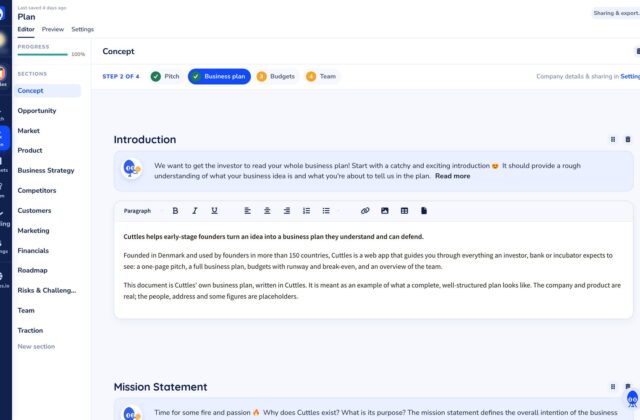
In Cuttles, you enter the costs in the budget’s Expenses tab as one-time or recurring items, and the money you put in on the Capital tab, for example an owner contribution in month one. The Dashboard then shows monthly burn rate, runway and the month you break even, and the Financials section of the business plan pulls in the same charts, so the text and the numbers never drift apart. If you write the Financials text yourself, the [AI] Polish button can tighten your wording without touching the figures you wrote.

If part of the money will come from outside, check the startup grants database for programs that fund early costs. Funding match, which pairs your plan with grants and investors, is coming to every yearly Cuttles plan. And if you want to keep the total small, our guide to bootstrapping your business covers how to launch on less. Once you know your cost base, the break-even point formula tells you how many sales it takes to cover it, and our guide to burn rate shows how to track it after launch.
Startup Costs Checklist
Run through this before you put a number in front of anyone.
- Every one of the 40 lines is marked yes, no or not yet.
- The five largest items are backed by written quotes.
- Each cost is marked one-time, recurring or both.
- Every recurring cost has a start month.
- Founder pay is included, even if it is a small number.
- Revenue is forecast month by month from customers times price.
- The operating shortfall is the sum of the months where costs exceed revenue.
- Contingency is a separate line, with a reason for the percentage.
- Payment terms (paying suppliers early, getting paid late) are in the cash flow.
- The plan shows where each dollar of startup capital comes from.
- Your accountant has seen which costs count as start-up costs for tax.
We need [total] to launch [company]. This covers [one-time total] in one-time costs, mainly [two largest items], and [shortfall] to fund operations until revenue covers costs in month [number]. We have added a [%] contingency of [amount] because [reason]. The founders contribute [amount], and we are seeking [amount] from [source].
Sources
- U.S. Small Business Administration, Calculate your startup costs (one-time vs. monthly expenses, common expense categories).
- Internal Revenue Service, Publication 583, Starting a Business and Keeping Records ($5,000 start-up and organizational cost deductions, $50,000 phase-out).
- Internal Revenue Service, Guide to business expense resources (Publication 535 discontinued after the 2022 revision; where the topics moved).
- Internal Revenue Code, 26 U.S.C. § 195, Start-up expenditures (text via Cornell Law School LII) (amortization over 180 months).
- GOV.UK, Register your company (Companies House online registration fee).
- HMRC, BIM46351: Pre-trading expenditure, scope (expenses up to seven years before trading).
- Northline Studio and Suds & Tails are fictional companies. All figures in the examples are illustrative and calculated from the stated assumptions.
Price the big items, date every cost, fund the gap, and keep the buffer where you can see it. — Cuttles