How to Validate a Business Idea Before You Build It (7 Tests)

Most failed products worked fine. Nobody wanted them enough to pay. Learning how to validate a business idea is about finding that out for a few hundred dollars and a few weeks, instead of a year of savings. This guide gives you seven tests, from free desk research to real pre-sales, with a question script, the conversion math and a pass or fail line for each.
- A Market Validation section in your plan, right below market size, with a guide and example
- A one-page pitch builder for problem, solution, customers and traction
- A budget that shows whether your tested price and costs add up to break-even
What It Means to Validate a Business Idea
An idea is validated when you have evidence, not opinions, that three things are true: a specific group of people has the problem, they care enough to change what they do today, and enough of them will pay your price. Each of those is a separate claim, and each needs its own test. Friends saying “I’d use that” proves none of them.
Validation is also cheaper than it sounds. Paul Graham’s essay on startup ideas makes the point that the best ideas usually start from a problem someone actually has, often the founders themselves, rather than from brainstorming. That changes the job. You are not trying to prove your solution is clever. You are trying to find out whether the problem is real, common and painful enough to pay to fix.
| Claim | Question | Tests that answer it |
|---|---|---|
| The problem exists | Do people have it, and how often? | Search demand, competitor evidence, problem interviews |
| They care enough to act | Will they give time, email or attention? | Landing page, mockup test |
| They will pay your price | Will they hand over money? | Concierge MVP, pre-sales |
Before you start, write down your riskiest assumption in one sentence. For most ideas it is either “people have this problem badly enough” or “they will pay this much”. Run the cheapest test that could prove it wrong first. The free startup idea validator is a quick way to list your assumptions and see which ones you have not tested yet.

The 7 Validation Tests, From Cheapest to Strongest
The tests are ordered by cost and by strength of evidence. Your first two take an afternoon at a desk. The last two involve real money changing hands, which is the only signal that cannot be faked by politeness.
- Search demandAre people looking for a fix?
- Competitor evidenceIs anyone paying for one?
- Problem interviewsHow do they cope today?
- Landing pageWill strangers sign up?
- Mockup testDoes your solution fit?
- Concierge MVPWill they use it done by hand?
- Pre-salesWill they pay before it exists?
To make the tests concrete, each one shows how a fictional startup would run it. Tidewell is a made-up company: a service that schedules and coordinates cleaning between guest stays for short-term rental hosts with one to five listings, priced at $39 per listing per month. All numbers in the example are illustrative, and the math is shown so you can reuse it.
Test 1: Search demand
If people have a problem, many of them search for a way to fix it. Use Google Trends to see whether interest in the problem is rising, flat or seasonal, and Google Keyword Planner (free with a Google Ads account) for rough monthly search volumes. Search for the problem, not your product name: “how to schedule cleaners between guests”, not “Tidewell”.
- Pass: several problem phrases have steady or rising searches, and the results include forum threads of people asking for help.
- Fail: almost no one searches for the problem in any wording. That does not kill the idea (some needs are unspoken), but it means marketing will be harder and you need stronger evidence from interviews.
Test 2: Competitor evidence
Competitors are good news at this stage: they prove people pay for a solution. Make a list of direct competitors, substitutes and workarounds. Read their pricing pages, their customer reviews and their job postings. Reviews are free primary research written by your future customers. Look for complaints that repeat: “too expensive for one property”, “built for big agencies”, “setup took a week”.
- Pass: people pay for existing solutions, and reviews show a gap that fits your angle.
- Fail: no one sells anything close and no one has tried. Either you found something rare, or the problem is not worth paying for. Treat “no competitors” as a question, not a win.
Test 3: Problem interviews
This is the core of market validation research. Talk to 15 to 20 people who match your customer definition, one at a time, for 20 to 30 minutes. Y Combinator’s guidance on talking to users makes two points worth taping to your screen: the goal is to learn, not to pitch, and hypothetical questions (“would you use a tool that…?”) produce unreliable answers. Ask about what people did last time, not what they might do. Rob Fitzpatrick’s book The Mom Test is a good short read on the same idea.
1. Tell me about the last time you [had the problem]. What happened?
2. How often does that happen? When was the most recent time?
3. How do you handle it today? Walk me through the steps.
4. What does that cost you, in time, money or stress?
5. What have you tried to fix it? Why did you stop using that?
6. Are you paying for anything related to this now? How much?
7. If you could change one thing about how this works, what would it be?
8. Who else deals with this problem? Could you introduce me?
Do not describe your idea until the last five minutes, if at all. Write down exact phrases they use.
After each interview, score it: did the person have the problem in the last month, are they already spending time or money on it, and did they show emotion about it? Count the results.
The founder interviews 18 hosts with one to five listings, recruited through host forums and a local host meetup. 14 of 18 had a cleaning mix-up in the last three months. 11 of 18 coordinate cleaners by text message and a shared calendar. 9 of 18 already pay a co-host or assistant partly to handle turnovers. The phrase that keeps coming up: “I’m on my phone during every checkout.”
- Pass: most interviewees had the problem recently and already spend time or money on a workaround. Set your number before you start; for Tidewell, the founder decided in advance that 10 of 18 would be enough to continue.
- Fail: people agree the problem exists but cannot remember the last time it happened, or have never tried to fix it.
Test 4: Landing page (smoke test)
A landing page tests whether strangers care enough to act. Build one page that describes the problem and your solution in the customers’ own words, with one call to action: join the waiting list, or reserve a spot. Send paid traffic from people who match your target group, so you measure strangers rather than friends. Decide your pass line before you spend anything.
Tidewell spends $300 on ads targeted at short-term rental hosts. At an illustrative $1.50 per click, that buys 200 visitors. 18 of them join the waiting list: a 9% sign-up rate (18 ÷ 200).
Each person who signs up sees a second step: reserve a founding spot by paying the first month for one listing, $39, fully refundable. 5 of the 18 pay. That is 27.8% of sign-ups (5 ÷ 18) and 2.5% of all visitors (5 ÷ 200). Cost per paying customer: $300 ÷ 5 = $60.
The pass line, set in advance: hosts in the interviews averaged two listings, so a customer pays about $78 a month (2 × $39). At an assumed 80% gross margin, that is $62.40 of gross profit a month. The founder wants to earn back acquisition costs within three months, so Tidewell can afford to pay up to $187.20 per customer (3 × $62.40). The test came in at $60, well inside the line. Expect that cost to rise once the early adopters are gone, which is why the margin of safety matters.
- Pass: cost per paying customer is below what your unit economics can afford, with room to spare.
- Fail: plenty of sign-ups but almost no one takes the paid step. That usually means the problem is real but the price or the offer is off. Change one thing and run it again.
Build your pass line from your own numbers, not from a benchmark you read somewhere. The unit economics guide shows how to work out what a customer is worth to you.
Test 5: Mockup test (solution interview)
Once you've confirmed the problem is real, check whether your solution actually matches it. Pick five to ten of the people you interviewed and put a clickable mockup in front of them, or even just screenshots you've sketched in a slide tool. Ask them to complete a task ("book a cleaner for Saturday's checkout") and observe in silence, without stepping in to help. Write down the moments they pause, what they assume will happen next and any features they ask for that are missing.
- Pass: people complete the task, describe the product back to you correctly and ask when they can use it.
- Fail: people get lost, or they finish the task and say “nice” with no follow-up. Politeness is not interest.
Test 6: Concierge MVP
In a concierge MVP you deliver the result by hand, with no product built, to a handful of real customers. It tests whether people use the service repeatedly and teaches you what the software actually needs to do. Paul Graham’s essay “Do Things That Don’t Scale” argues that this kind of manual, one-customer-at-a-time work is how many startups get going.
The founder takes on the 5 hosts who paid in Test 4, 10 listings in total. For four weeks, she coordinates every cleaning herself with a spreadsheet and text messages: 60 turnovers in the month, about 15 hours of her time, or 15 minutes per turnover. At the end of the month, 4 of the 5 hosts pay for month two. The work log shows that most of her time goes to last-minute booking changes, which becomes the first feature to build.
- Pass: customers keep paying after the first month and would be annoyed if you stopped.
- Fail: they use it once and drift away, or they only stay while it is free.
Test 7: Pre-sales
Money before the product exists is the strongest validation signal there is. For consumer products, that can be a refundable deposit, a pre-order or a paid waiting list, as in Test 4. For B2B products, it can be a paid pilot or a signed letter of intent that states a price and a start date. Be straight with buyers about what exists today and when they get it, and refund promptly if you don’t deliver.
- Pass: people pay, or sign a letter with a price, without heavy discounting. Two or three paying B2B customers can be enough evidence for a first plan.
- Fail: everyone likes it, nobody signs. Ask the people who said no what would change their mind, and write down the answers.
Validation Scorecard: Cost, Time and Signal
| Test | Typical cost | Time | Strongest pass signal |
|---|---|---|---|
| 1. Search demand | Free | An afternoon | Steady searches for the problem, not just the category |
| 2. Competitor evidence | Free | A day | People pay for alternatives and complain about a gap you fill |
| 3. Problem interviews | Free, or small thank-you gifts | 1 to 3 weeks | Recent problem plus money or time already spent on it |
| 4. Landing page | Ad spend you choose | 1 to 2 weeks | Cost per paying customer below your limit |
| 5. Mockup test | Free to low | 1 week | Users complete the task and ask for access |
| 6. Concierge MVP | Your time | 4 weeks or more | Customers pay for a second month |
| 7. Pre-sales | Low | Ongoing | Payment or a signed price before launch |
Costs and timings are rough guides for a small founding team. Set your own pass line for each test before you run it.
Business Idea Validation Checklist
- Your riskiest assumption is written down in one sentence.
- Each test has a pass line written before the test started.
- You interviewed at least 15 people who match your customer definition, not friends or family.
- Interview results are recorded as counts, with quotes in the customers’ own words.
- You know what customers use today and what it costs them.
- Landing page traffic came from strangers in your target group.
- You measured sign-up and payment as separate conversion steps.
- Your cost per paying customer is below what your unit economics allow.
- At least a few people have paid, pre-ordered or signed a letter with a price.
- You know which feature to build first, based on what customers actually did.
What to Do With the Results
If most tests pass, you have what you need to write the plan: a problem in your customers’ words, a first segment, a tested price and early traction. If a test fails, change one variable at a time (the customer group, the problem framing, the price, the channel) and rerun it. Several failures on the same claim are a clear answer too, and a cheap one.
For a broader look at whether the business can work, including costs, operations and legal questions, run a feasibility study. To size the market your tests point to, see our guide to market analysis for a business plan, and use the problem statement guide to turn your interview notes into one clear paragraph.
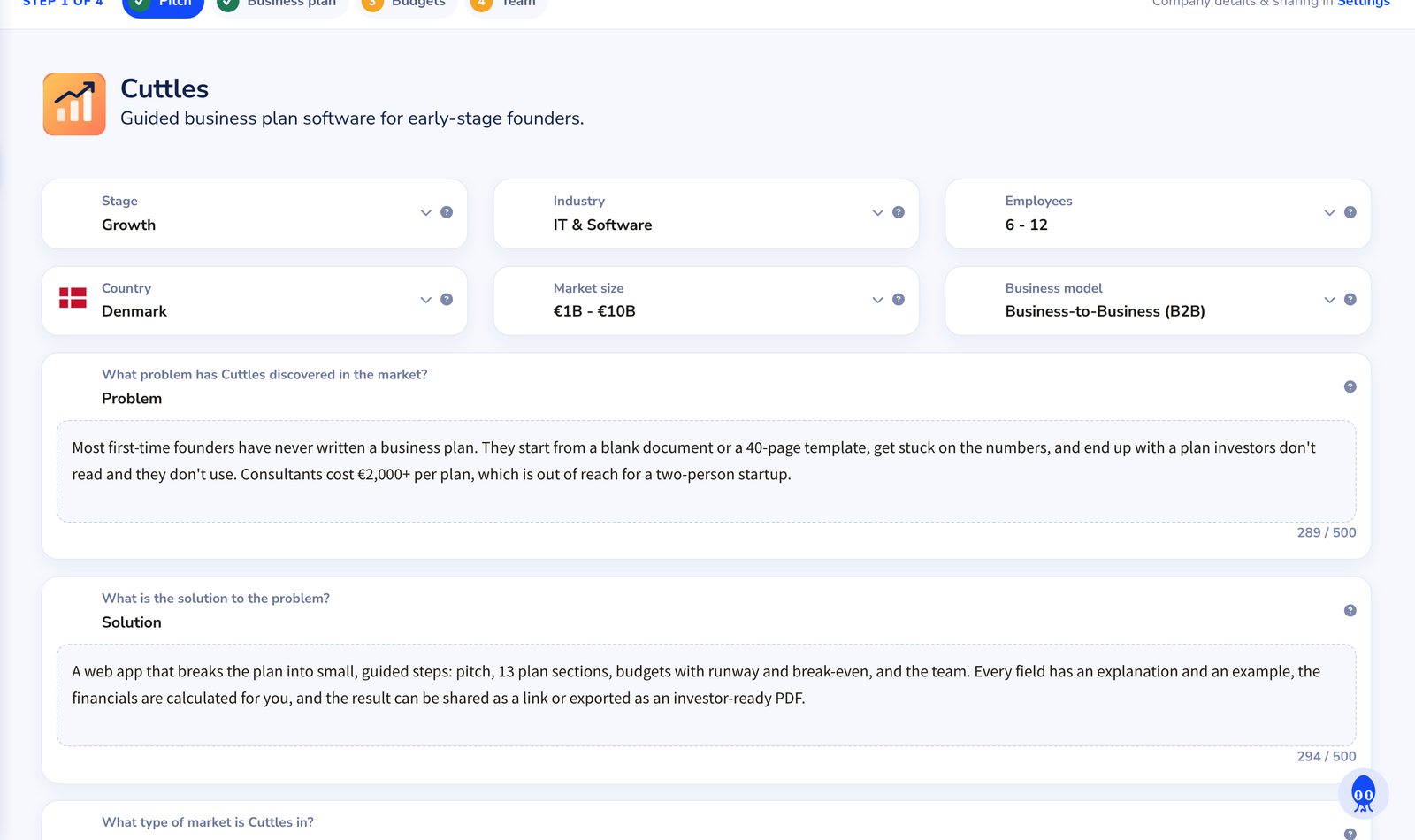
Then put it in writing. In Cuttles, the evidence goes into the pitch’s Problem, Customer Segments and Traction fields, and into the plan’s Market Validation and Traction sections. Write each field in your own words first; the [AI] Rewrite this and [AI] Polish buttons can tighten the wording afterwards. The price you tested goes into the budget, which shows whether it reaches break-even. Our guide on how to write a startup business plan walks through the rest.
Sources
- Paul Graham, How to Get Startup Ideas (start from problems people actually have).
- Paul Graham, Do Things That Don’t Scale (manual, one-customer-at-a-time work in the early stage).
- Y Combinator, How to Talk to Users (learn, don’t pitch; avoid hypothetical questions).
- Google, Google Trends and Google Keyword Planner.
- Tidewell is a fictional company. The cost per click, conversion rates, margin and all other figures in the example are illustrative and calculated from the stated assumptions.
Test the claim most likely to be wrong, and let people’s wallets settle the argument. — Cuttles